Blind Baby Sleep: The Montessori Day-Night Rhythm

If your baby is blind or has very low vision, the usual advice to get daylight in the morning and dim the evening may not be doing anything at all. Light is the signal that sets a body clock to 24 hours, and a clock that cannot receive it does not simply run late — it can drift, further each day. The work moves to the cues that are left: a fixed wake time, meals at the same hours, a room whose layout never changes, and a bedtime sequence the child can feel coming. That is a prepared-environment problem, not a diagnosis — if light perception is in question, that conversation belongs with your child’s ophthalmologist and early intervention team before any blog, this one included.
Why this genuinely is a different problem
Most sleep advice quietly assumes a working light channel. A 2017 review in Frontiers in Neurology puts the dependency plainly: “Daily retinal light exposure is necessary for the synchronization of the circadian rhythms with the external 24-h solar environment.” Without it the clock runs on its own period, usually not exactly 24 hours — a 2016 paper in the same journal gives the measured average as about 24.5 hours, across a range of roughly 23.8 to 25.1. Half an hour a day sounds trivial. It is not: bedtime walks forward around the clock over a few weeks, so a child sleeps beautifully for a stretch, then badly, then beautifully again, in a pattern no routine explains.
The condition is non-24-hour sleep-wake rhythm disorder, and the 2017 review reports that “over half of totally blind patients may have non-24 SWRD.” Two caveats: most of that literature is about adults, and light perception matters even without usable sight — in the group described there, 39% of people without light perception had non-24, against 9% among those with some. “Blind” is not one condition, which is why the eye team comes before the shelf.
Start with the team, not the routine
The ophthalmologist. Whether there is any light perception, and what the diagnosis is, changes the whole picture — including whether timed light exposure is worth trying at all. Sleep is legitimate to raise at an eye appointment.
Early intervention. In the US, vision services are a named category under IDEA Part C, covering “evaluation and assessment of visual functioning” and “orientation and mobility training for all environments.” A teacher of students with visual impairments and an orientation and mobility specialist do exactly this work, in your house. Ask your pediatrician for a referral.
On melatonin: the Cochrane review of it for non-respiratory sleep disorders in visually impaired children found no randomised trials meeting its criteria, concluding there is “no high quality data to support or refute” its use — an argument for it being a clinician’s decision, not a blog’s.
What the prepared environment can actually anchor
My standing, plainly: three years setting up shelves in a toddler community, no guide’s diploma, no training as a specialist teacher of blind children. Doctrine from the certifying bodies, practice from the specialists.
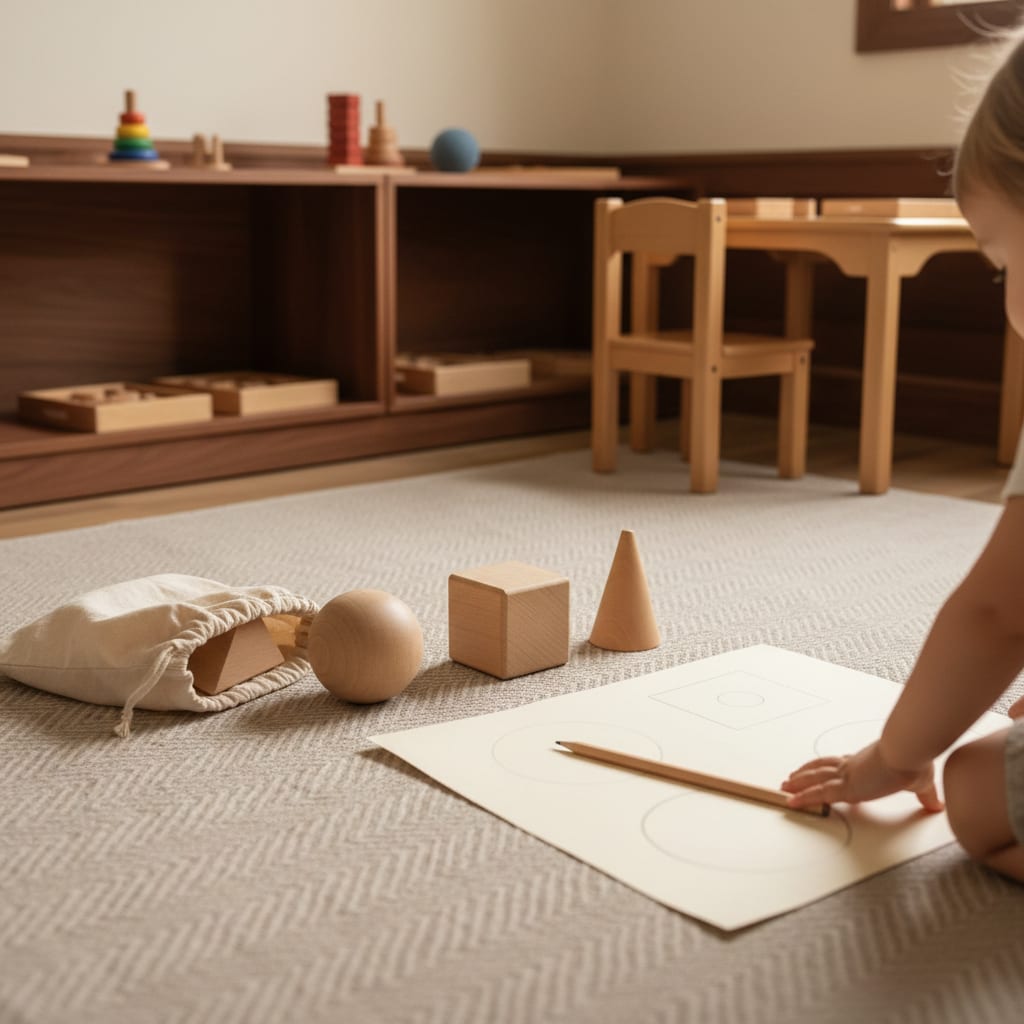
The American Montessori Society describes the adult’s job as preparing an environment “with carefully selected, aesthetically arranged materials that are presented sequentially to meet the developmental needs of the children using the space.” Take aesthetically out — it does no work for a child who cannot see it — and what remains is the point: selected, arranged, sequential. A prepared environment is one whose order is predictable, and here that order has to arrive through everything except the eyes.
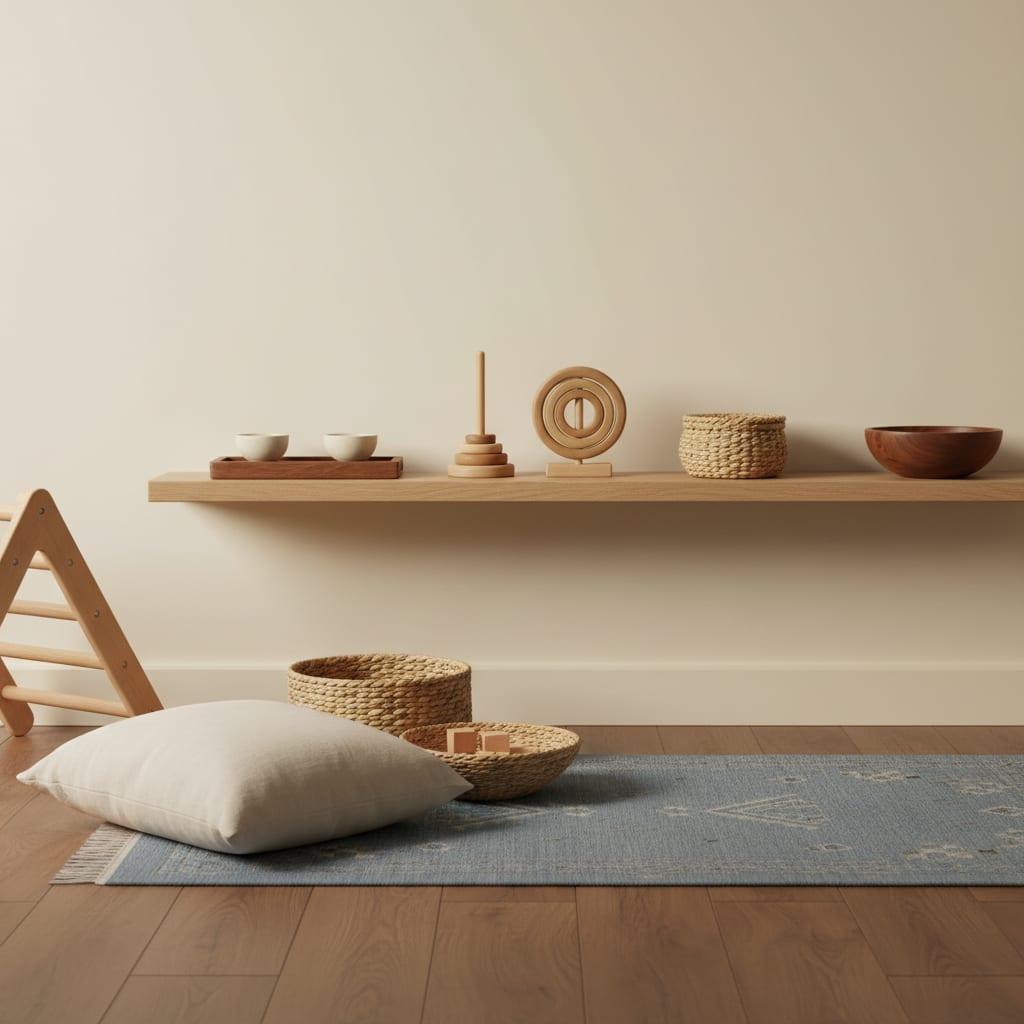
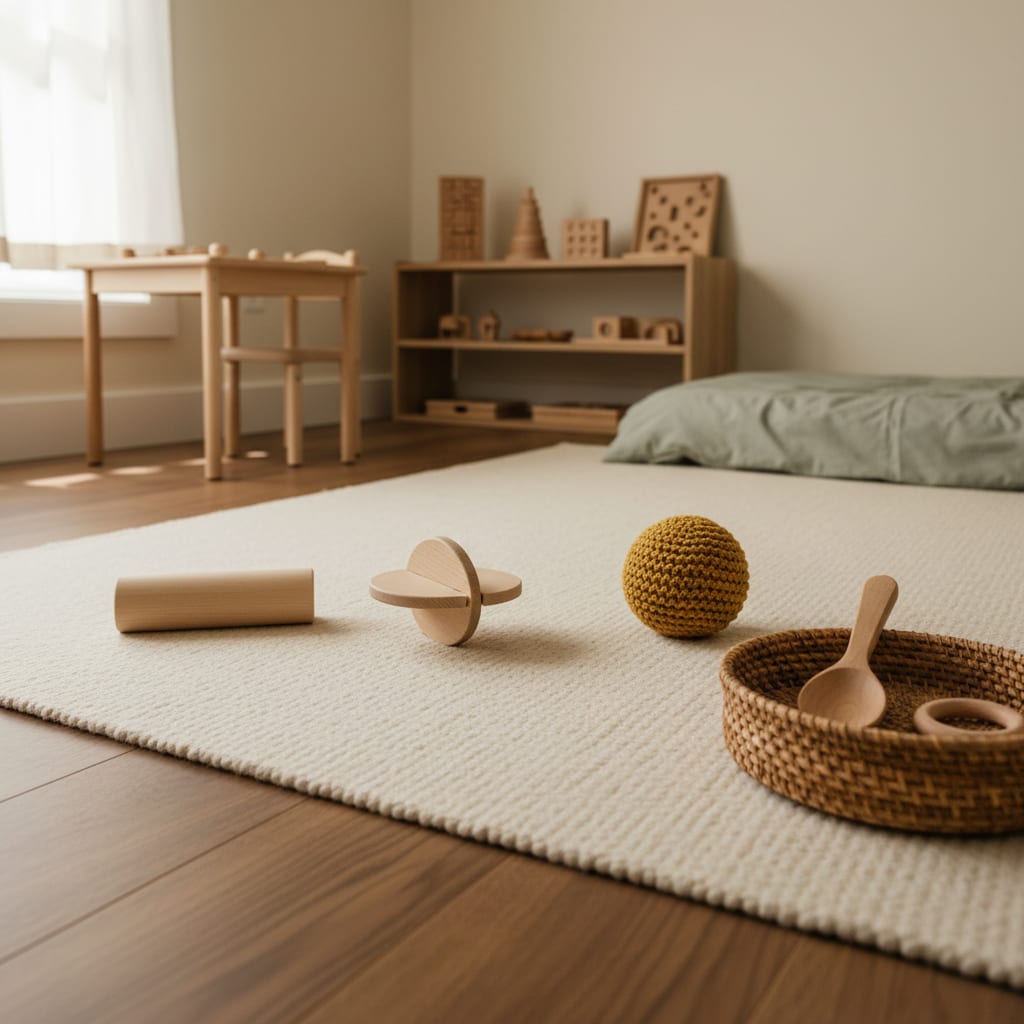
- Nothing moves. Bed, basket, chair, door, rug edge. A room learned by hand and foot is re-learned whenever furniture moves, and a child re-navigating at 2am is now awake. The strict version of the ordinary Montessori infant room setup rule, not a different one.
- Surfaces say where you are. A change of floor texture at the threshold, a wool rug beside the bed, a wooden rail on the shelf — a doorway you can feel.
- The sequence is the signal. Same order, same objects, same words, every night. What a sighted baby gets from the light going down, yours gets from step four following step three.
- Say the time out loud. “Breakfast, it’s morning” gives a spoken timeline to a child with no visible one. LeAndra Monsen, writing at WonderBaby about her daughter, describes doing this all day — one parent’s account rather than a study, but the habit costs nothing.
The three anchors that do the heaviest lifting
When light is gone the remaining cues are behavioural, and they only work if they are boring.
A fixed wake time, seven days a week, including after a terrible night. It is the anchor everything else hangs from, and letting it float is what lets a drifting rhythm keep drifting.
Meals at fixed hours. Feeding times are among the strongest non-light cues available, and unlike light they are entirely within your control — keep the intervals the same at weekends. If you are still working out what they should be at your baby’s age, Betteroo’s feeding schedule by age lays the pattern out by month.
Activity loaded into the first half of the day, then withdrawn in the evening. The contrast between an active morning and a quiet evening does the job daylight does elsewhere — the same mechanic as ordinary newborn day-night confusion, except that here the contrast has to be manufactured rather than merely reinforced.
Do not cut naps to force night sleep: an overtired baby sleeps worse, and nap needs at this age are developmental.
A steady, unchanging sound is the closest thing to a room signature a non-visual child can have. A mechanical machine like the Yogasleep Dohm Classic beats a phone app: same sound, same level, all night, no auto-shutoff and no notifications. Keep it low, away from the head of the bed, and use it at night only — a sound that runs all day cannot mark the night.
The room, and watching for drift
The floor-bed argument is stronger than usual here — a bed with no bars can be left and returned to under the child’s own power — but the safety floor does not move for it. AAP guidance, stated as being “for babies up to 1 year of age,” asks for back sleeping on a firm flat surface in “a crib, bassinet, portable crib or play yard that meets the safety standards of the Consumer Product Safety Commission.” A floor mattress is not one of those regulated products, so under twelve months the crib comes first: read what a floor bed actually requires, then run the floor bed safety checklist — everything in that room will be found by hand.
The most useful thing to bring to an appointment is a record. Keep a plain log for two weeks — the method in the two-week sleep log is the same one — but read it for pattern rather than quality. You are looking for sleep onset and wake time moving consistently in one direction, half an hour at a time, then wrapping around. That signature separates a drifting clock from ordinary bad nights, and is very hard to see from memory.
 Is the rhythm drifting, or just a rough week?
Betteroo turns your child's age and real sleep data into a personalized day-by-day plan — useful for spotting a pattern before your next appointment.
Take the 2-minute sleep quiz →
Is the rhythm drifting, or just a rough week?
Betteroo turns your child's age and real sleep data into a personalized day-by-day plan — useful for spotting a pattern before your next appointment.
Take the 2-minute sleep quiz →
FAQ: sleep without light cues
Does a blind baby still need a dark room at night?
If there is any light perception, treat darkness as worth having — partial perception often keeps a rhythm entrained. If there is none, darkness costs nothing but does nothing either, and the effort is better spent on the fixed wake time and meal hours. Melatonin is a question for the pediatrician, not a shelf change.
Will my child definitely develop a drifting sleep rhythm?
No. It is common in totally blind adults but far from universal, and less likely where some light perception remains — a possibility to watch for with a log, not an outcome to brace for.
Is there a Montessori position on this?
Not specifically — Montessori wrote no protocol for blind infants, and anyone claiming one is overreaching. What transfers is the principle: order in the environment is what lets a child act independently. Here it is carried by touch, sound, smell and sequence, and held far more strictly.
What should I bring to the appointment?
Two weeks of times: when the baby fell asleep, when they woke, when every feed happened — not impressions of how the nights felt. A clinician can read drift out of times; nobody can read it out of “he’s been terrible lately.”