Montessori Silence Game: 6 Variations for Home
The Silence Game is a Montessori exercise in which a group — or one child and one adult — deliberately makes no sound at all for a short stretch, in order to hear what was underneath the noise. It is an invitation, never an instruction, and it lasts seconds before it lasts minutes. Done properly it isn’t a behavior-management trick; it’s a sensorial lesson in control of movement and in listening, and children who have played it a few times will start asking for it. Here’s the classic presentation, six variations that keep it alive at home, and the ways it goes wrong.
Where the exercise comes from
The story usually told is that Montessori carried a sleeping baby into a classroom, remarked on how perfectly still and quiet the baby was, and found the children spontaneously trying to match it — the room going quieter than she had ever managed to make it by asking. Out of that she built a formal exercise: not silence imposed, but silence achieved together, with the reward being the sounds that only appear once you stop making your own.
I’m a former classroom assistant, not a trained guide, so for the doctrine — where the exercise sits in the sensorial and grace-and-courtesy sequences, and how it’s presented in an AMI or AMS classroom — go to the training organizations themselves, AMI and AMS, or to Montessori’s own writing. What follows is what survives contact with a living room.
What it is not
Three clarifications that save a lot of disappointment:
- It is not a punishment or a settling tactic. The moment “let’s play the Silence Game” becomes what you say when everyone is shouting, it’s dead. Play it when things are already calm.
- It is not stillness for its own sake. The point is hearing — the fridge, a bird, the radiator, a car two streets away. Silence is the method; the sounds are the content.
- It is not compulsory. A child who opts out sits and watches. Coercing silence is a contradiction in terms and children spot it immediately.
Ages and expectations
Realistically it starts to work somewhere around three, when a child can hold an intention for a few seconds and enjoys the joke of it. Under three, the shorter listening games below are the useful version. From four to six it gets genuinely good — thirty seconds to a couple of minutes, requested unprompted. School-age children can sustain several minutes and will invent their own variations, which is when you know it’s landed.
The first attempt lasting five seconds is a normal first attempt. Length is not the measure; wanting to do it again is.
The first presentation, step by step
- Choose a calm moment — after a meal, at the end of a work cycle, not in the middle of a wild afternoon.
- Sit down on the floor and let the child settle near you. Don’t announce a lesson.
- Say very quietly that you’re going to try to make no sound at all, and that afterwards you’ll say what you heard.
- Make yourself completely still first. Your stillness is the lesson; children copy the body, not the instruction.
- Close your eyes if it helps, and wait — ten seconds is plenty for a first go.
- End it deliberately. In a classroom the guide whispers each child’s name from across the room and they come, one at a time, moving as silently as they can. At home, whisper their name once.
- Compare notes. “I heard the fridge and a bird.” Let them go first if they want to. Then stop; don’t extend it because it went well.
Repeat once or twice a week at most. Overuse is what kills it.
Six variations that keep it alive
1. The listening list. Sit in silence for thirty seconds, then take turns naming every sound you heard. The naming half is quietly excellent vocabulary work, and it pairs neatly with the object-and-language exercises in Montessori language activities for toddlers.
2. The whispered name. The classroom version, and the favorite. One adult sits across the room and whispers each child’s name; the child crosses the room without making a sound. With one child, hide behind a door and whisper from there.
3. Silence outdoors. Same exercise in a garden, a park or a wood. The results are so much richer than indoors that it’s worth making this the version you use in summer — insects, wind in different trees, distant traffic, your own footsteps stopping.
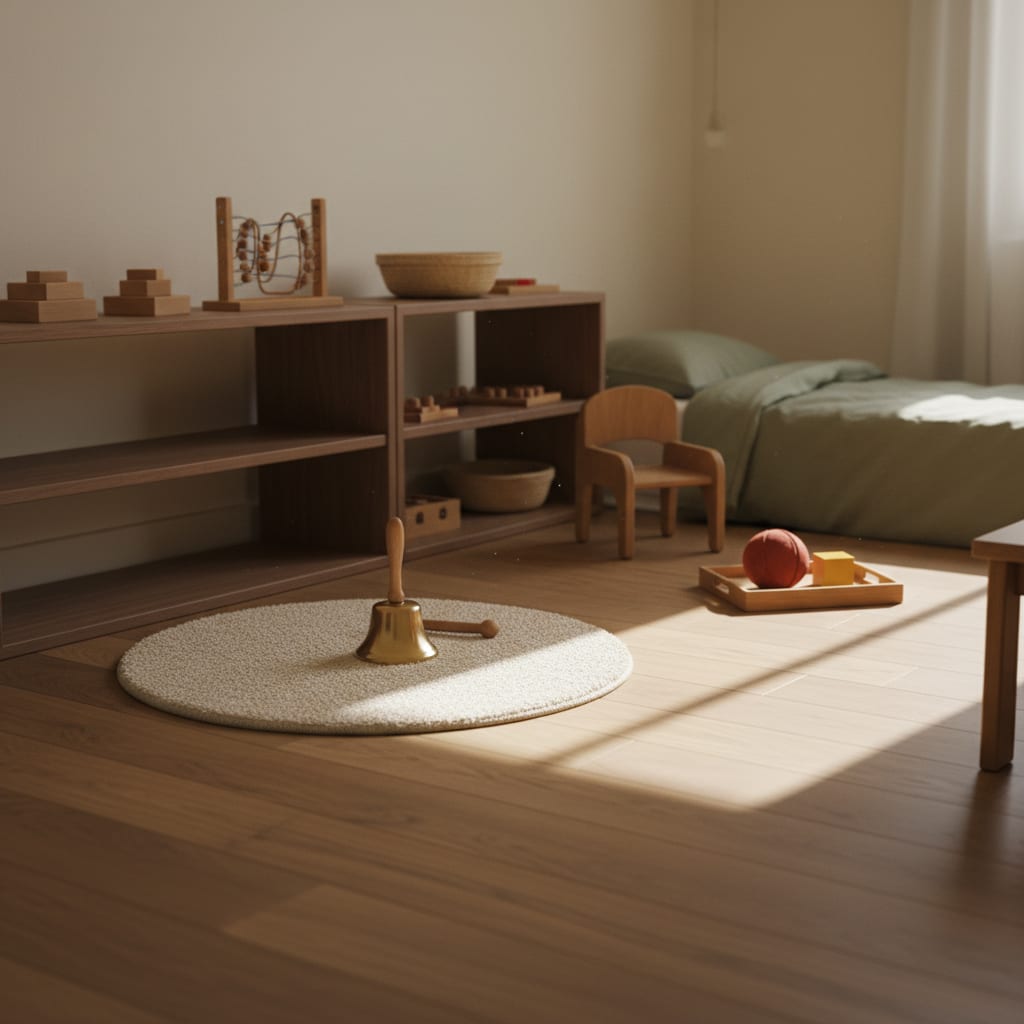
4. The bell fade. Ring a single bell or strike a chime, and the game is to stay still until the sound has completely disappeared, then raise a hand. It gives a young child a concrete finish line, which is why it works below four.
5. Silence with a candle or a single object. Everyone watches one thing — a candle flame at a safe distance, a spinning top slowing down, a leaf on a plate. Attention has somewhere to go, which makes stillness much easier for the child who fidgets.
6. The sound hunt. After the silence, everyone goes to find and touch the thing that made one of the sounds. It turns a contemplative exercise into a movement one, which is often exactly what a four-year-old needs to be willing to do the contemplative part at all.
Common mistakes
- Making it a competition. “Who can be quietest” turns listening into surveillance of each other.
- Praising the winner. Notice the sounds, not the performance: “I heard the radiator” beats “you were so good at that”.
- Running it too long. End it while they still want more. Always.
- Using it every day. Weekly keeps it special; daily makes it a routine to resist.
- Talking through it. Your commentary is noise. If you have to signal, use your hand.
Where it fits in a normal week
The Silence Game is a small, occasional thing that pays off somewhere else — in a child’s tolerance for their own concentration, and in their willingness to be uninterrupted. It sits naturally alongside the environment-level work in helping your child concentrate, and it’s a good opening ritual for the post-nap stretch described in Montessori quiet time — thirty seconds of listening, then everyone goes to their own thing.
If you want to see the exercise handled by people running it with groups, Trillium Montessori writes it up from a classroom perspective and Montessori in Real Life from a home one. Between them you’ll find more variations than any one house needs.
FAQ: the Montessori Silence Game
What age can you start the Silence Game?
Around three for the full exercise. Under three, use the shorter listening versions — the bell fade or a ten-second “what can you hear?” — which give the same sensorial experience without asking for sustained stillness.
How long should the Silence Game last?
Ten to thirty seconds at first, a minute or two by four or five, longer only if the children themselves want it. Ending early and leaving them wanting more is the whole trick.
What do you do if a child won’t stay silent?
Nothing. They watch, or they leave and come back. The exercise depends entirely on being chosen, and a child who sits out three times running will usually join the fourth.
Is the Silence Game a discipline tool?
No — and using it as one is the fastest way to lose it. Play it when the room is already calm, never as a response to noise or misbehavior.