Montessori Activities for 18 Month Olds: What Holds Attention
The Montessori activities that hold an 18-month-old’s attention are the ones that match what this age is driven to do: carry the heaviest thing they can find, post objects through slots, open and close every container, join in real household jobs, and hear the real name of everything. Set out four to six simple activities on a low shelf, each with its own place, and add one real job a day (wiping, sweeping, carrying the shopping). Expect a lot of repetition and short bursts. That is what concentration looks like at 18 months.
I was a classroom assistant in a Montessori toddler community, not a trained guide, so for the “why” I link to certified teachers’ writing.
What changes around 18 months
Simone Davies, an AMI-trained teacher who writes The Montessori Notebook, lists the shifts she sees around 18 to 21 months. Movement: “Climbing, running and maximum effort become important.” Language: it “often starts exploding around 18 months.” Order: “knowing where things are and what comes next becomes super important.”
The CDC’s 18-month milestone checklist describes the same child from the outside. By 18 months, most children copy you “doing chores, like sweeping with a broom”, drink “from a cup without a lid”, try to use a spoon, and climb “on and off a couch or chair without help”. They also put their hands out for you to wash them and help with dressing by pushing an arm through a sleeve.
Build the activities around that: a child who wants to copy real work and move heavy things. Ages are guidelines only; watch what your own child is working on.
Maximum effort: let them carry the heavy thing
Davies explains the term simply: “Maximum effort is when children like to carry the heaviest objects they can find.” Her suggestions are household ones, like heavy shopping, cans or heavy bottles.
You do not need to buy anything for this. Ideas from an ordinary house:
- Carrying the shopping bag with two cans in it from the car to the kitchen.
- Pushing a laundry basket of towels down the hall.
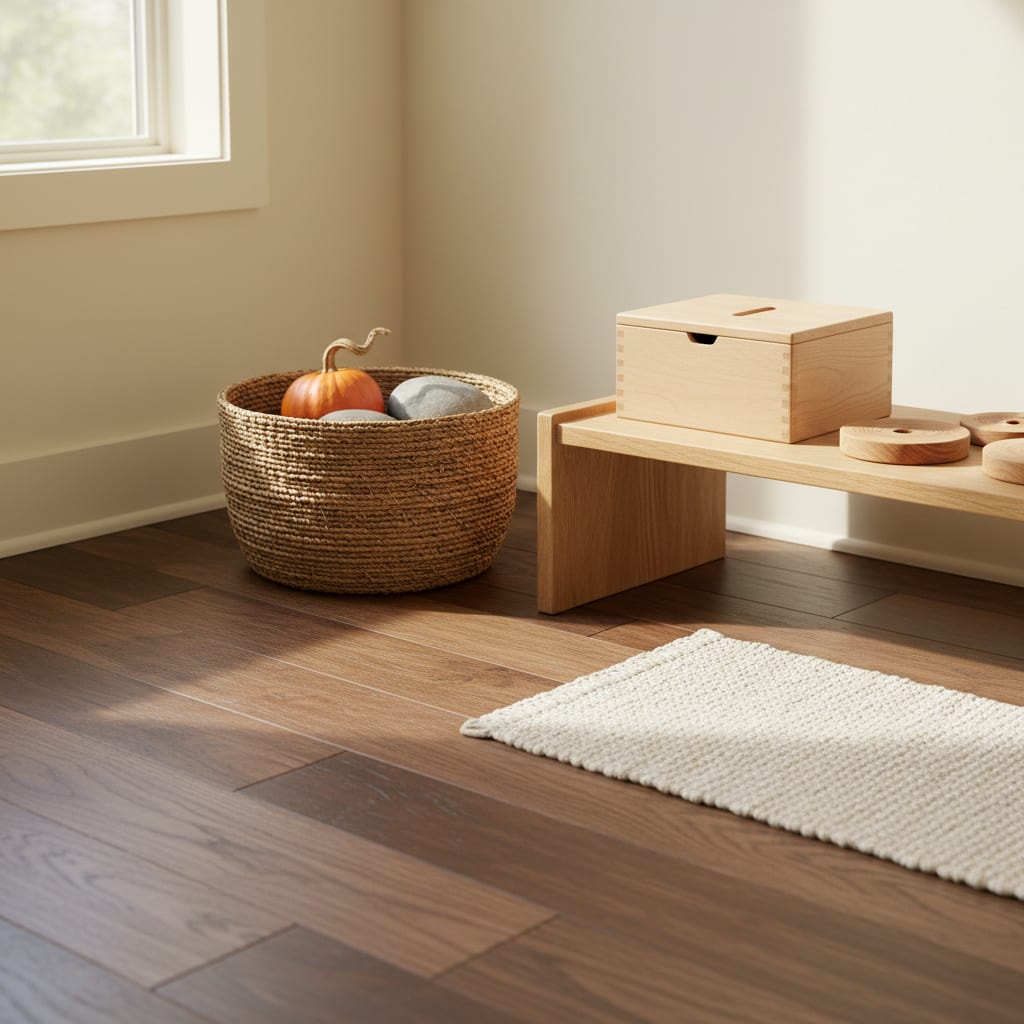
- Carrying a small pumpkin or a full watering can to the door.
- Moving floor cushions from the sofa to the reading corner and back.
Choose things that are heavy for them but safe to drop, and clear the path. The struggle is the point.
Hand work that holds attention
Davies’s 18-to-21-month shelf includes a stacking and sorting board, a posting box, ball hammering, an “opening and closing” basket of small purses and boxes, a simple nuts-and-bolts toy, and colour sorting. Her 21-to-24-month list adds a peg puzzle, posting sticks into a cheese shaker, and threading large wooden pieces.
Each has a clear, repeatable action and a visible result. Good home versions:
- Posting. A tin with a slot cut in the lid and a few large flat wooden discs. Make sure every piece is too big to fit in the mouth.
- Opening and closing. A basket of three or four containers with different fastenings: a zip purse, a snap pouch, a box with a lid. Hide one small, safe object inside each.
- Posting sticks. An empty spice or cheese shaker with large holes, and short thick wooden sticks.
- Hammering. A ball-and-hammer or peg toy. Check the age on the box, because many are labelled for two and up.
The choking line first. At this age everything still goes into the mouth sometimes. The AAP’s choking prevention page says to keep coins, marbles, small balls, toys with small parts and “Toys that can be squeezed to fit entirely into a child’s mouth” away from young children, and to follow the age guidance on toy packages. That is why the posting box above uses wooden discs, not the coin box you often see in photos.
First real jobs
This is where 18 months differs most from 12. Davies suggests “simple one step activities like pouring a glass of water or wiping a spill”, adding steps as the child masters them. One step means one action with a clear end: wipe the table, put the cup on the counter, put the shoes in the basket.
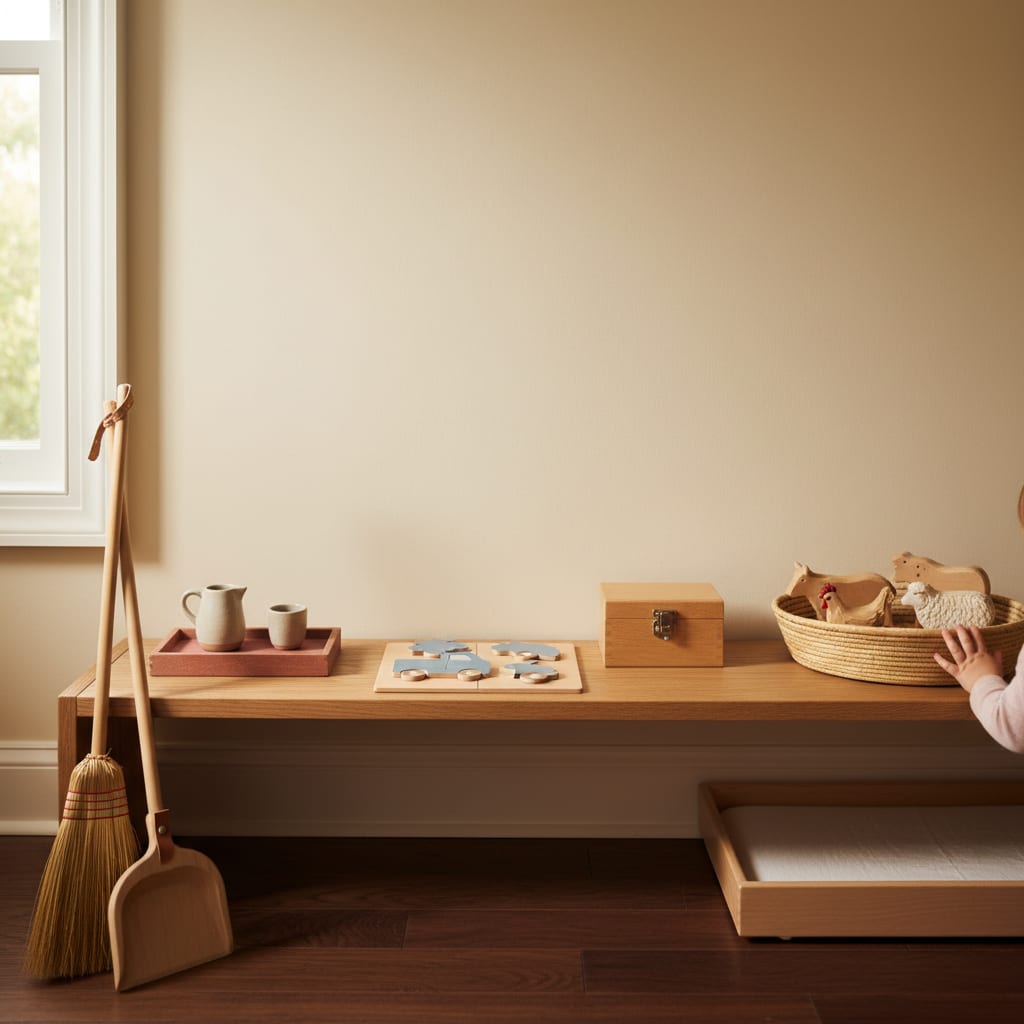
Give the child real, child-sized tools, because they want the real job, not a toy version of it. A small hand brush and dustpan, like the Redecker horsehair set, suits the “copies you sweeping” stage exactly, and it actually picks up crumbs.
I won’t repeat the full ladder of jobs here. Pouring, spooning, table-laying and the rest of this stage are set out in the practical life activities by age guide, and household jobs in Montessori chores by age. For kitchen jobs, the Montessori kitchen for toddlers covers the stool, the child’s shelf and the first real food work.
Language: name everything, exactly
Davies recommends giving children “rich language, real names of everything around them”, and taking time to listen when they talk. At 18 months, this works better woven into the day than set up as a lesson:
- Name precisely. “That’s a colander”, not “that thing”.
- Talk through the job while you both do it, in short sentences.
- Read a few pages of a book together. The CDC notes that by 18 months most children look “at a few pages in a book with you”, which is a few pages, not the whole book.
The CDC also lists “Tries to say three or more words besides ‘mama’ or ‘dada’” for this age. If language seems well behind, that is a question for your pediatrician, not something an activity shelf can fix.
Order: a place for everything
Because order matters so much at this age, the environment does more teaching than you do. Davies suggests a shelf with activities on trays and in baskets, a place for the child’s bag and coat by the door, and “a place for everything (with everything in its place)”.
In practice:
- Four to six activities on a low shelf, each in its own basket or tray, each always in the same spot.
- One hook by the door for coat and bag.
- Put the activity back with the child when they finish. They will not do it alone yet, but they learn where it goes.
- Rotate one or two activities a week, not the whole shelf.
The child who is upset when the cup is in the wrong cupboard is showing that need for order. A predictable room and day keep them calm.
How long it lasts, and when to stop
Expect anything from thirty seconds to ten minutes, and expect the same activity twenty times in a row. Davies notes that at this age “when they find the activity they are working to master, they’ll repeat again and again.” Don’t interrupt that. When the child wanders off or starts throwing, put the activity away together and let them choose another.
If attention seems to fall apart in the late afternoon, check whether the day is too long. A child running on empty stops concentrating long before they stop moving. Betteroo’s rundown of what to expect at this age covers sleep alongside the skills, and notes that nearly all toddlers have moved to a single nap by 18 months. And if you are coming from the stage before, the Montessori activities for 1 year olds week shows where these activities grew from.

FAQ: Montessori activities for 18-month-olds
What Montessori activities are good for an 18 month old?
Carrying heavy things, posting objects through slots, opening and closing containers, simple puzzles, and one-step real jobs like wiping, sweeping and carrying a cup to the counter. Keep four to six activities on a low shelf and rotate them.
What is “maximum effort” in Montessori?
It is the drive, strong around 18 months, to carry and push the heaviest things a child can manage. Montessori teachers suggest letting toddlers carry real heavy items like shopping bags or a laundry basket.
How long should an 18 month old focus on an activity?
There is no fixed time. Short bursts and lots of repetition are normal. Let your child repeat an activity as often as they want, and put it away together when they lose interest.
Do I need Montessori toys for an 18 month old?
No. Most of the best activities use household things: containers to open, cans to carry, a cloth to wipe with.