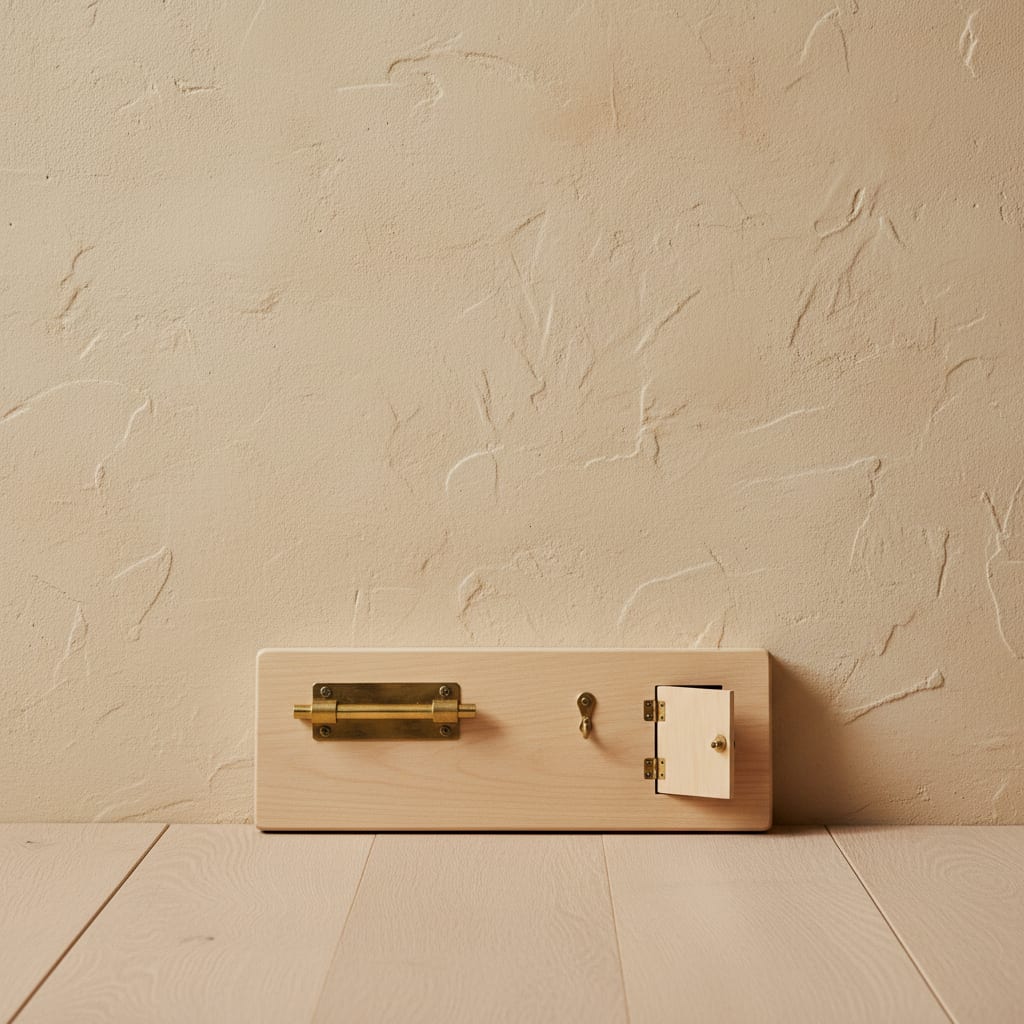
A Montessori busy board is worth having when it does one thing well: it lets a toddler practise real mechanisms, such as a sliding bolt, a hook and eye, a hinge or a latch, on plain wood, with nothing that lights up or plays a tune. Those are the same movements a child needs for the doors, drawers and cupboards in your house, which is why a good board counts as practical life rather than as a gadget. Most boards on sale are the opposite: eighteen or twenty mechanisms crowded together, often with lights and buttons. A simpler board, offered for a few weeks and then moved on, gets more use.
I was a classroom assistant in a Montessori toddler community, not a trained guide. The Montessori principles below come from the American Montessori Society, the battery safety from the American Academy of Pediatrics, and the buying advice is what tends to survive a real house.
What a busy board is for
A busy board is a panel of hardware a child can operate: things that open, close, slide, turn and fasten. Toddlers are fascinated by mechanisms because the house is full of them and adults use them all day. A board brings a few within reach at a height and in a setting where the child can repeat them as often as they like.
In Montessori terms that is practical life. The American Montessori Society’s core components page defines practical life as “domestic” work to maintain the home, self-care, and grace and courtesy, and says these skills “form the basis of later abstract learning.” Opening a latch is not domestic work on its own. But the hand that has practised a bolt on a board is the hand that will soon slide the bolt on the garden gate or open the cupboard where the cups live.
So the test for any board is simple: does each thing on it exist in real life, and does it work the way the real one does?
What the Montessori lens rules out
The same AMS page describes Montessori materials this way: “Each carefully crafted material focuses on a single skill or concept and follows a logical sequence.” Hold most busy boards up to that sentence and they fail in three ways.
Too many mechanisms. A board with eighteen activities is eighteen invitations to touch something and move on. It is the same problem our toy guide for 1-year-olds warns about with activity cubes: six busy sides, and nothing that holds attention. Four to six mechanisms is plenty.
Electronics. Switches that light a bulb, buttons that play a sound, a music box. As what makes a toy Montessori puts it, if the toy is doing something, the child isn’t. A real light switch on the wall does something. A plastic one on a board only flashes.
Pretend hardware. Painted-on clocks, mechanisms that don’t fully close, plastic “locks” that open without the key. If the latch doesn’t latch, it teaches nothing.
The battery problem
Light-up boards usually run on batteries, and some use button or coin cells. The AAP’s page on button and lithium coin batteries lists games and toys among the items that use them, and says a swallowed battery needs urgent care. Its advice is to “make sure battery compartments are secure,” and to consider “taping them shut for an additional layer of security.” It also suggests posting the National Battery Ingestion Hotline number (800-498-8666) with your other emergency numbers.
A board with no electronics avoids the question entirely. If you already own one with lights, check that the battery cover is screwed shut before it goes back on the shelf.
What a good board looks like
- Four to six mechanisms, spaced so each has room for a whole hand.
- Real hardware. A barrel bolt, a hook and eye, a hinged door, a chain lock, a turn latch, a wheel or knob that spins. Metal parts should be smooth and firmly screwed in.
- Plain wood or a calm finish. Busy colours compete with the mechanism, and the mechanism is the point.
- A reason behind every door. A small mirror, a photograph of a family member, or nothing at all, so the reward is opening it.
- No lights, no sound, no batteries.
- Heavy, or fixed. A board that slides on the floor gets abandoned. A heavy board lying flat, or a panel screwed to a low wall at the child’s height, stays put.
One worked example
The Melissa & Doug Latches Wooden Activity Board is one widely sold board that fits the description: a wooden board built around latches, with no electronics. It is labelled for ages 3 and up, so follow the label. For a younger toddler, the “board” can be your own house, with you beside them.
Make your own instead
A home-made board is often better, because you choose the mechanisms your child actually meets. Use a sanded offcut of plywood, screw on four or five pieces from a hardware store, check every screw from the back, and round every edge. Choose hardware that matches the house: if your gate has a bolt, put a bolt on the board.
How to offer it
Treat the board like any other shelf work.
- Show one mechanism slowly without talking, then step back.
- Leave it on the shelf for a few weeks, then rotate it out. A board left out for months stops being noticed. Our toy rotation system explains the cycle.
- Move to the real thing. When your child has mastered the bolt, show them the real bolt on the gate and let them do it while you watch. That is the moment the board has done its job.
- Supervise. Small hinges can pinch fingers, and any loose part is a choking risk. Check the screws and hinges every time it comes back out of rotation.
 Busy hands all day. Restless nights?
Betteroo builds a gentle, personalized sleep plan around your toddler's age, naps and bedtime, starting with a free quiz.
Take the free sleep quiz →
Busy board or real cupboards?
A busy board is a stepping stone, not the destination. A Montessori home’s real goal is a child who can open the cupboard where their own cups live, slide the bolt on the shed and close the door behind them. If your house already gives your toddler a few safe mechanisms to use every day, a low cupboard with a simple catch or a gate they are allowed to open with you, you may not need a board at all. If it doesn’t, a small, honest board is a fine way to bring a few within reach while the house catches up.
FAQ: Montessori busy boards
Are busy boards Montessori?
Not by origin. No classic Montessori material is called a busy board. A board with a few real mechanisms fits Montessori practical life well. A crowded, light-up board does not.
What age is a busy board for?
Children start working mechanisms in the second year, but many boards on sale are labelled for 3 and up because of small parts. Always follow the label on a bought board, and supervise any home-made one.
How many activities should a busy board have?
Four to six is enough. More mechanisms tend to mean less attention on each one.
Should a busy board have lights or sounds?
No. Electronics make the board do the work, and some use button batteries, which the AAP treats as an emergency if swallowed.