The best Montessori climbing toy is the one that matches your child’s stage and your floor space. Soft foam blocks suit a baby who is crawling and pulling up. A Pikler triangle suits a toddler from roughly the first steps to about age four, and lasts longest. A rocking arch adds balance work once a child climbs confidently, and a ramp mostly extends a triangle you already own. If you can only fit one, the triangle covers the widest age range. Whatever you choose, the Montessori part is how it is used: the child climbs only as high as they can get by themselves, on a soft surface, with a clear space around them.
I was a classroom assistant in a Montessori toddler community, not a trained guide or a physical therapist. The milestones below come from the CDC, the safety points from the CPSC as summarised by Betteroo, and the rest is what I’ve seen work in ordinary rooms.
Why climbing belongs in a Montessori home
Climbing is how toddlers practise balance, strength and judging distance. The CDC’s 18-month checklist lists “Climbs on and off a couch or chair without help” among its movement milestones, and its 2-year checklist includes “Walks (not climbs) up a few stairs with or without help.” In other words, a toddler is going to climb whether you buy anything or not. The question is whether they climb the bookcase or something built for it.
A climbing toy in a Montessori home sits in the movement area, not in a playroom of its own. Our post on setting up a Montessori playroom shows how a movement corner fits beside the shelf and the reading spot.
The four types, by age
Soft foam blocks (about 9 months to 2 years)
Large foam shapes, such as wedges, steps and cylinders, that a baby can crawl over and pull up on. They are the gentlest start, because nothing is hard and nothing is high, and you can rearrange them into a new course each week.
The ECR4Kids SoftZone Climb and Crawl Active Playset is a well-known five-piece set in earth tones, listed for 9 months to 3 years. The limits of foam: older toddlers outgrow the height quickly, and foam blocks take up floor space without folding away.
Pikler triangle (about 10 months to 4 years)
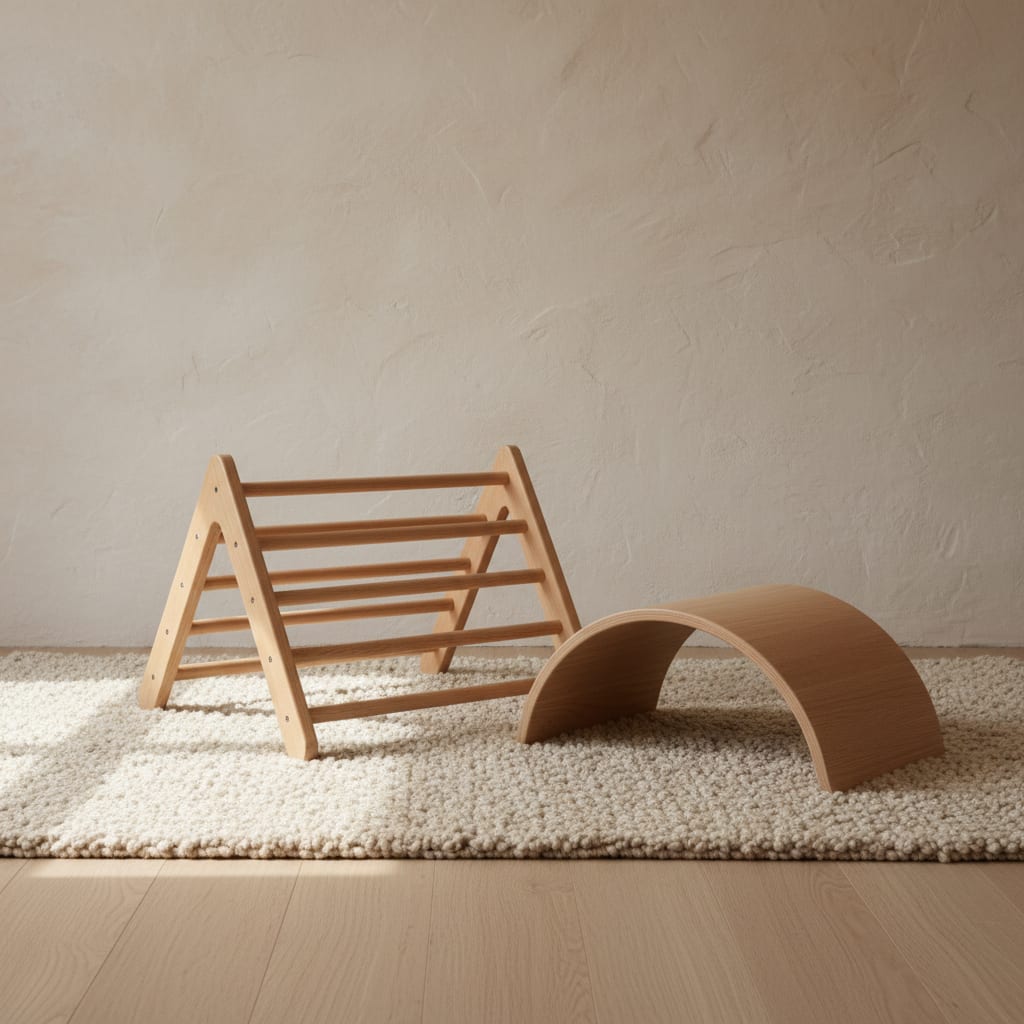
A wooden frame with ladder rungs on two sides. Babies use it to pull up and cruise; toddlers climb up and over; preschoolers turn it into a fort. It covers the widest range of any piece here, which is why it is the one most families buy if they buy one. It comes from Emmi Pikler’s free-movement tradition rather than from Montessori, but it fits a Montessori movement area well. Our Pikler triangle guide covers stability, rung feel, height and foldable models in detail, so I won’t repeat it here.
Rocking arch (about 18 months to 5 years)
A curved wooden arch with rungs. Upright, it is a low climbing frame; flipped, it is a rocker or a tunnel. It asks more of balance than a triangle, because it moves, so it suits a child who already climbs steadily. On its own it is a good second piece rather than a first one. Look for wide rungs, a frame that rocks smoothly without tipping fully over, and enough floor space in front and behind for the rocking.
Ramp (with a triangle, about 18 months and up)
A board, usually reversible, with climbing slats on one side and a smooth slide on the other. It hooks onto a triangle’s rungs. On its own it is not much, but with a triangle it adds new ways to use the set: climb up, slide down, crawl up the smooth side. If you already have a triangle and want to extend it, this is the best value.
Choosing by space
- Small flat, little floor space. A foldable triangle, stored behind a sofa, or a few foam blocks that double as seating.
- A room you can leave set up. Triangle plus ramp, with an arch added later.
- A baby under a year. Foam blocks first. Add the triangle when your baby is pulling up steadily.
- Two children of different ages. A triangle and an arch, set apart, so the younger child isn’t climbing in the older one’s landing zone.
Fall zones and anchoring
Every climbing piece needs a clear space around it and something soft underneath.
- A fall zone on every side. Nothing hard within reach of the top: no table edges, radiators, windows or shelves.
- A soft surface. A thick rug or play mat under and around the frame. Hard floors and thin rugs are not enough.
- Never next to furniture a child could climb onto from the top. A triangle beside a bookcase turns the bookcase into the next rung.
- Anchor the room, not just the toy. Betteroo’s guide to motor skills by age has a climbing-safety section passing on the CPSC’s advice to “use anti-tip brackets on dressers, bookcases and other top-heavy furniture.” A child who has learned to climb a triangle will try the dresser too.
- Check the hardware. Folding hinges should lock so a toddler can’t release them, and bolts should be tight. Check them each time you set the frame up.
The Montessori rules of use
What makes a climbing toy Montessori is not the wood. It is three habits on the adult’s side.
- Don’t put your child on it. A child who climbed up by themselves can usually climb down. A child who was lifted up often can’t.
- Don’t lift them off the top. Show them how to come down feet first instead. Climbing down is the harder and more useful skill.
- Stay close without narrating. Hover a hand if you need to, but skip the constant “careful!” A child who keeps looking at your face is not looking at their feet.
 A climber by day. Out of bed by night?
Betteroo builds a gentle, personalized sleep plan around your toddler's age, naps and new skills, so a busy body still settles at bedtime.
Take the free sleep quiz →
What to skip
- Tall frames for a young toddler. Height should match ability. A frame your child can only use with your help works against the whole idea.
- Wobbly, cheap frames. If the frame racks when you shake it, it will rack when your child is at the top.
- Climbers with no space around them. A climbing toy squeezed into a corner between furniture is worse than none.
- More pieces than you have room for. Multi-piece sets look generous, but most homes only have space to leave one or two pieces out at a time.
For where climbing fits on a toddler’s shelf alongside puzzles, real work and language objects, our list of Montessori toys for 2-year-olds has a section on big movement.
FAQ: Montessori climbing toys
What is the best Montessori climbing toy?
For most families, a Pikler triangle, because it covers the widest age range. Foam blocks are better for a baby, and an arch is a good second piece for an older toddler.
What age is a Montessori climbing toy for?
Foam blocks from about 9 months, a triangle from about 10 months when a baby is pulling up, and an arch from about 18 months. Use your child’s skills rather than their age.
Are climbing toys safe indoors?
They can be, with a soft surface underneath, a clear fall zone and furniture anchored to the wall. Supervise young climbers, and let your child climb only as high as they can get by themselves.
Do I need a ramp and an arch as well as a triangle?
No. A triangle on its own is enough. A ramp extends it, and an arch adds balance work. Add them only if you have the floor space.