Montessori Toys for 4 Year Olds: A Realistic Shelf
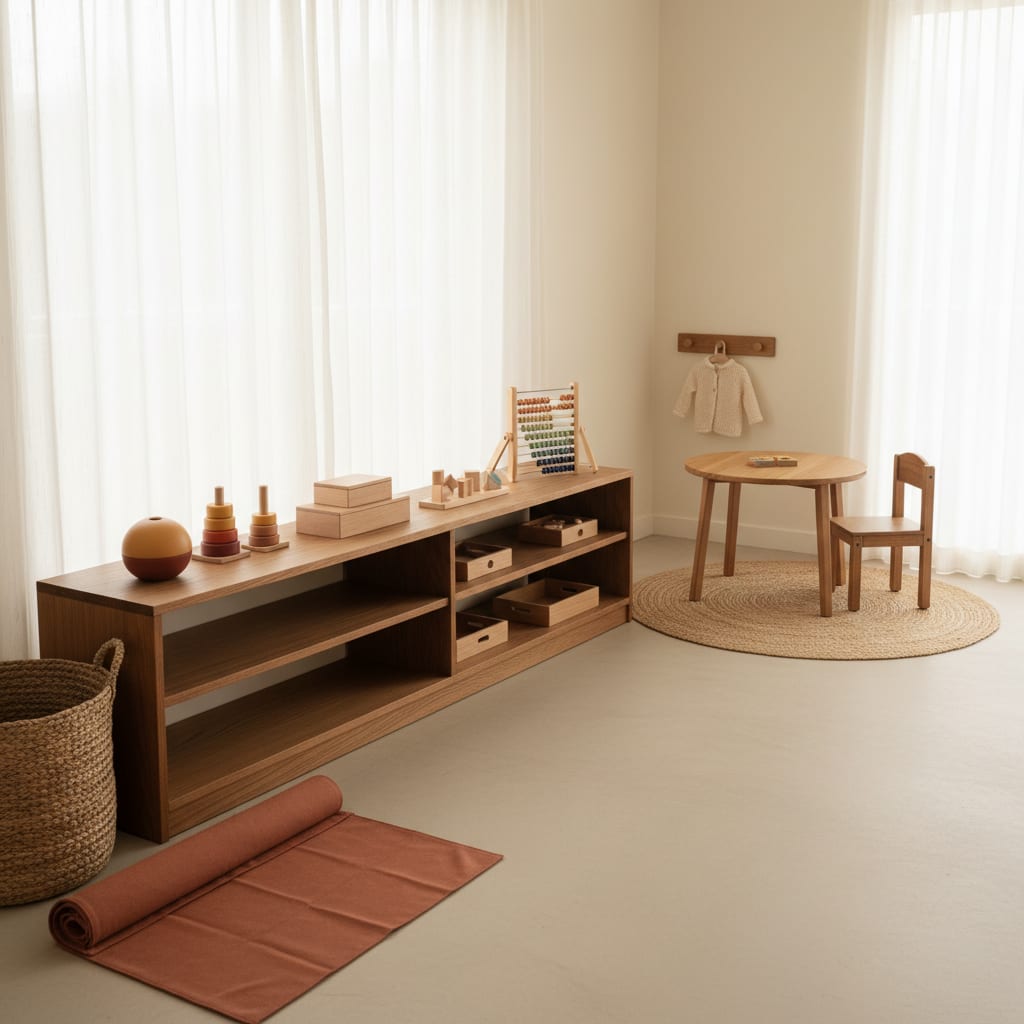
The best Montessori toys for 4 year olds are harder versions of real work plus the first steps of the classroom’s language and math sequence: real scissors and sewing, sandpaper letters or a movable alphabet for a child who knows some letter sounds, pattern blocks and plenty of real things to count, a map puzzle, realistic animal figures, and one cooperative game. Keep it to eight to ten choices on a low shelf and rotate the rest. Skip expensive classroom replicas, especially if your child attends a Montessori program. Four is when the classroom sequence starts to matter, and a home does not need to copy it.
The house test is the same one this site uses at two and three: would this get chosen weekly without me selling it? I was a classroom assistant in a Montessori toddler community, not a trained guide, so the doctrine below is linked to the American Montessori Society rather than asserted by me.
What changes at four
A four-year-old can work for much longer than a two-year-old, and wants harder work. The AMS’s Family Alliance guide for 4-year-olds puts it this way: “Mathematical thinking is emerging naturally from sensorial work. Concentration deepens dramatically. The child who was learning to pour water at two is now washing dishes independently.”
The CDC’s 4-year milestone checklist is a useful check on a shelf. The CDC defines a milestone as something “most children (75% or more) can do by a certain age”, so this is a floor most children have crossed, not a target.
| CDC 4-year milestone (CDC wording) | What on the shelf serves it |
|---|---|
| ”Holds crayon or pencil between fingers and thumb (not a fist)“ | Scissors, tongs, sewing, a drawing tray |
| ”Serves herself food or pours water, with adult supervision” | A real pitcher and glass at snack time |
| ”Names a few colors of items” | Pattern blocks, colour-sorting work |
| ”Tells what comes next in a well-known story” | Books, and one game with turns |
| ”Likes to be a ‘helper‘“ | Real jobs with real tools |
| ”Pretends to be something else during play (teacher, superhero, dog)“ | Nothing to buy; see the note below |
Betteroo’s guide to what most four-year-olds can do with their hands and words makes the same point I would about handwriting: “There is no need to drill handwriting; playdough, tweezers games, beading, and scissors work build the same hand strength with less resistance.” That is a good summary of half this shelf.
Practical life, now with real tools
At two, practical life is pouring and wiping. At four, it can be a whole job with steps: cutting, sewing, polishing, laying the table for everyone. The same AMS guide lists “Increasingly complex practical life: sewing, polishing, flower arranging.”
- Scissors that actually cut. Child-size blunt-tip scissors such as Fiskars’ 5-inch kids’ scissors, with a tray of paper strips to snip. Cutting along a line is a skill to practise, with an adult nearby.
- A first sewing work. A large blunt needle, thick thread and a square of loose-weave fabric or card with punched holes. Keep the needle on the tray and the tray where the toddler sibling cannot reach it.
- Flower arranging. A small jug, a few cut flowers and a cloth for drips. It has the whole work cycle in one tray, and this site’s flower-arranging post walks through it.
None of this is a “toy”, and all of it gets chosen more often than toys at this age.
Letters: only if the sounds are there
The AMS guide calls writing “PEAK” at four and describes the classroom approach: “In Montessori, children WRITE before they READ.” The usual materials are sandpaper letters (trace the letter while saying its sound) and a movable alphabet (loose letters to build words by sound).
- Sandpaper letters such as Didax lowercase sandpaper letters. Lowercase first, sounds not names.
- A movable alphabet. The classroom version is a box of loose wooden letters, like the Elite Montessori movable alphabet. The AMS guide itself says a DIY version is fine: “Magnetic letters on a cookie sheet work perfectly.” A box of Melissa & Doug wooden alphabet magnets on a baking tray is the cheap home answer.
Introduce these only to a child who already plays sound games (“what starts with mmm?”). The whole sequence, from sound games to reading, is in learning to read the Montessori way, so I will not repeat it here.
Math: count real things first
The classroom math materials are beautiful. The AMS describes the idea behind them as “concrete to abstract”, for example “learning the mathematical concept of the decimal system by working with Golden Beads grouped into units, 10s, 100s, and 1,000s.” Its Family Alliance guide suggests introducing those golden beads at four.
This is where I think a home should hold back. A full golden bead set is expensive, it is designed to be presented in a sequence by a trained guide, and if your child attends a Montessori school they will meet it there, properly. At home, the same “concrete first” idea costs nothing:
- Counting real things, one at a time, with a finger on each: spoons for the table, stairs, apples into a bag.
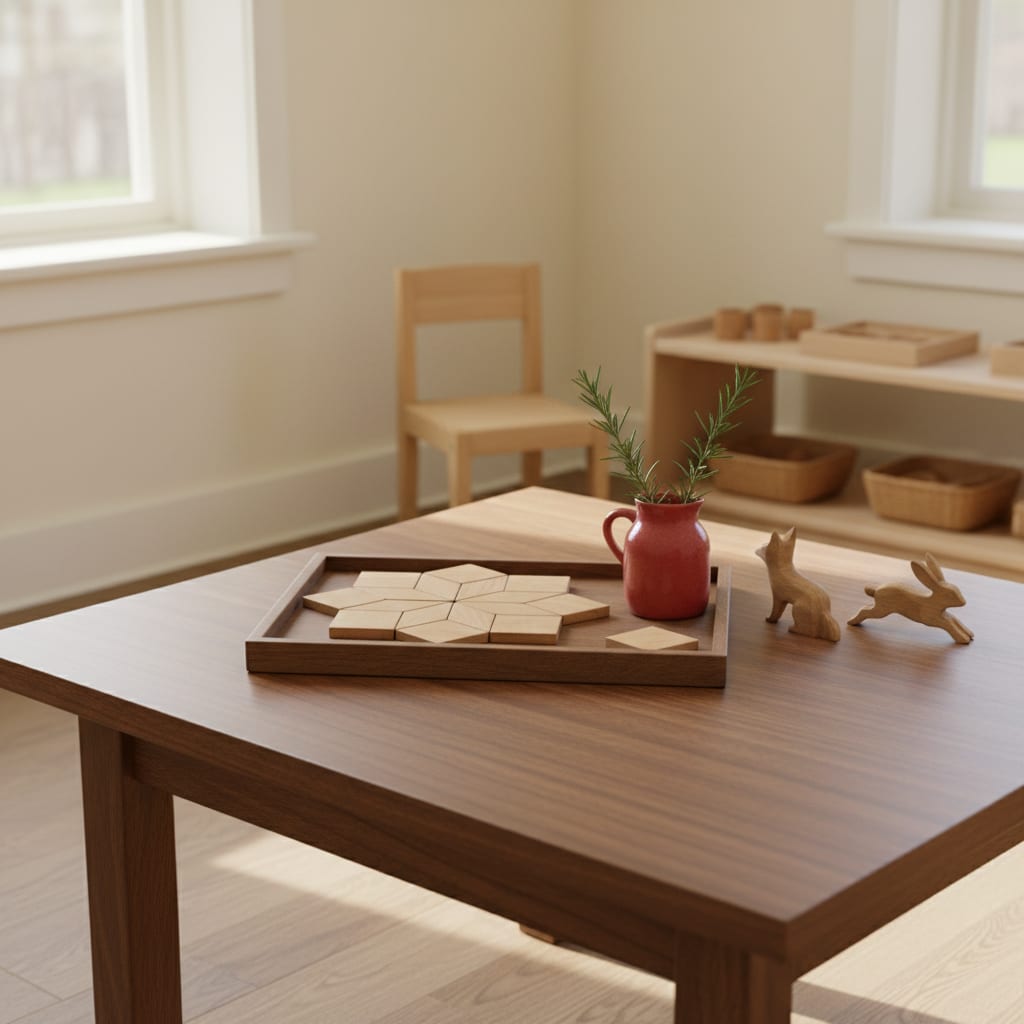
- Pattern blocks. Melissa & Doug’s Pattern Blocks and Boards are wooden shapes that fit together into pictures, with boards to match against. Shapes, colour, symmetry and fractions are all in the box, and nobody has to teach them.
- Sorting and matching, with real objects from around the house.
Maps, animals and the real world
Four-year-olds ask a lot of questions. Montessori answers them with real things and real words, and this part of the shelf is where that shows most.
- A map puzzle. The classroom uses wooden puzzle maps of the continents and countries. A Melissa & Doug USA map wooden puzzle is the home version, and it starts conversations about where grandparents live.
- Realistic animal figures. A small set of accurate animals, such as a Schleich Wild Life five-animal set, used with their real names. Pair them with a picture book about the same animals and you have the classroom’s object-to-picture work.
- A nature tray. Shells, a seed pod, a feather, a magnifying glass. Change it with the seasons.
One game, played together
Four is when turn-taking starts to work, with help. Losing still hurts, a lot. A cooperative game, where everyone wins or loses together against the board, gives the turn-taking practice without the tears. Peaceable Kingdom’s Hoot Owl Hoot, a cooperative colour-matching game, is the classic one. Play it together, and keep it on the shelf for when a friend comes over.
A note on pretend play
The CDC’s 4-year list includes pretending to be “something else during play”, and most four-year-olds do it constantly. Montessori writers disagree about how much make-believe material belongs in a home, especially for under-sixes. I am not going to settle that argument on a toy list. My house rule: realistic materials go on the shelf, and the dress-up box lives in the bedroom. Nobody is told to stop pretending.
What a home does not need to copy
- The pink tower, brown stair and spindle boxes. Iconic and expensive, and built for a guide’s presentation. Use nesting and stacking things you already have.
- The full golden bead set. See above.
- “Montessori” letter flashcards and worksheet kits. Flashcards teach letter names with nothing to touch. Sounds and movable letters come first.
- More than ten things at once. A four-year-old can concentrate for a long time, but only if the choice stays possible. Rotate the rest; the toy rotation system works the same at four as at two.
If you are coming from a younger child’s shelf, Montessori toys for 2 year olds and Montessori materials by age 3 show what comes before. Much of it still belongs at four, used in harder ways.
FAQ: Montessori toys for 4 year olds
What are good Montessori toys for a 4 year old?
Real practical-life tools (scissors, a first sewing work, a pitcher), sandpaper letters or a movable alphabet if your child knows some letter sounds, pattern blocks, a map puzzle, realistic animal figures and one cooperative game.
Should I buy Montessori math materials for home?
Usually not. Classroom math materials like the golden beads are built for a guide’s sequence, and children in a Montessori school meet them there. Counting real objects and pattern blocks cover the same ground at home.
How many toys should a 4 year old have out?
Eight to ten activities on the shelf, the rest stored and rotated. Fewer, harder choices hold attention longer than a full toy box.
Is pretend play allowed in Montessori?
Montessori writers disagree on this, especially for under-sixes. Most families keep realistic materials on the shelf and let ordinary pretend play happen everywhere else.