Montessori Sensitive Periods: A Parent's Plain Guide
In Montessori, a sensitive period is a stretch of time when a young child is intensely drawn to one kind of learning, such as order, language, movement, small objects or refining the senses, and absorbs it with unusual ease. Montessori described them from watching children, and they mostly fall in the first six years. For a parent, the useful part is simple: notice what your child is fixated on right now, and make it easy for them to do more of it. What the idea does not mean is that a missed “window” is gone forever.
I was a classroom assistant in a Montessori toddler community, not a trained guide, so the definitions below come from the two big Montessori organisations, quoted rather than paraphrased. The observations at home are mine.
What the term means
The American Montessori Society’s glossary of core components defines a sensitive period as “A critical time during human development when the child is biologically ready and receptive to acquiring a specific skill or ability—such as the use of language or a sense of order”. It adds that a Montessori teacher “prepares the environment to meet the developmental needs of each sensitive period.”
The Association Montessori Internationale’s archive glossary puts it this way: “Sensitive Periods are time spans in which the child is sensitive to an incredible degree to a particular activity or interest.” It says they “are universal in all children”, and that “Once the skill is obtained the sensitive learning period disappears.”
Notice what that last line says. The period ends because the child has got the skill. It is describing a burst of interest that fades once its work is done, not a door that slams on a child who was busy elsewhere.
Where it sits: the planes of development
Sensitive periods belong to a bigger Montessori idea. The AMS glossary describes four “planes of development”: “ages 0 – 6 (the period of the ‘absorbent mind’); 6 – 12 (the period of reasoning and abstraction); 12 – 18 … and 18 – 24 years”. It defines the absorbent mind as a period, from birth to about six, of “intense mental activity” that lets a child absorb learning from their environment “quickly and easily without conscious effort.”
The sensitive periods parents talk about are almost all in that first plane. AMI’s writing on imagination places the next big shift around five to six, when, as its imagination and fantasy page puts it, a child begins to “think about what could have happened in the past— or what could possibly happen in the future.”
The main sensitive periods, and what they look like at home
The AMI glossary names periods for “language, movement, order, refinement, obtaining culture, social cohesion, and of sensory perceptions.” Most parent guides group them into five or six. Here is what each tends to look like in a normal house. Ages are rough, and your child’s timing is their own.
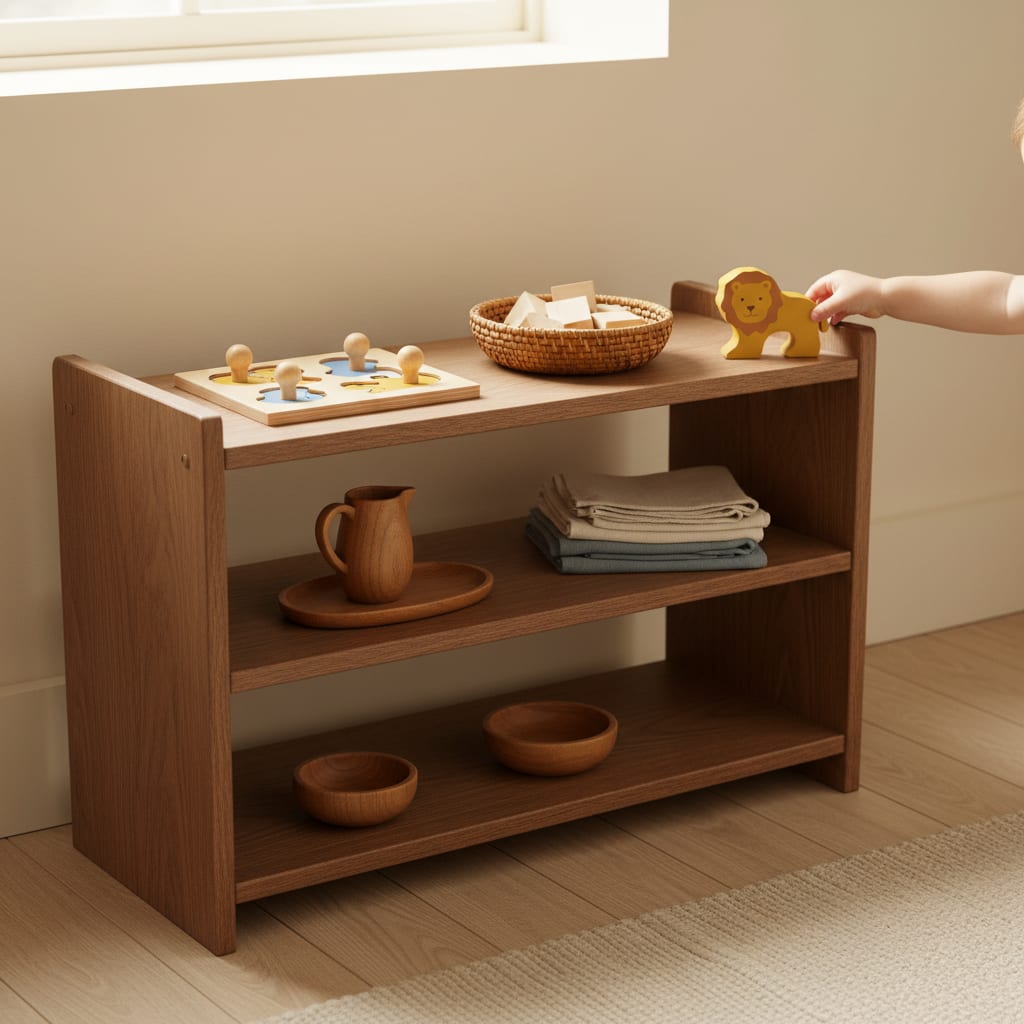
Order. The two-year-old who melts down because the cup is in the wrong cupboard, or because you took a different route to the park. AMS’s own Family Alliance guide for two-year-olds marks order as at its peak at two. Simone Davies of The Montessori Notebook notes that around 18 months “knowing where things are and what comes next becomes super important.” What helps: a place for everything, the same order to the day, warning before changes. A low shelf where every activity always lives in the same spot is largely an order project.
Language. The baby who stares at your mouth, and the toddler who wants the name of every object in the shop. AMS’s one-year guide calls this a “vocabulary explosion” stage. What helps: real, precise words, conversation, books about real things. Montessori language activities for toddlers has five ways to feed it. Betteroo has a useful rundown of when first words usually arrive if you are wondering where your child sits.
Movement. Pulling up on everything, climbing the sofa forty times, carrying the heaviest thing in the room. What helps: safe things to climb and real heavy things to carry. The Montessori activities for 18 month olds post covers the carrying stage.
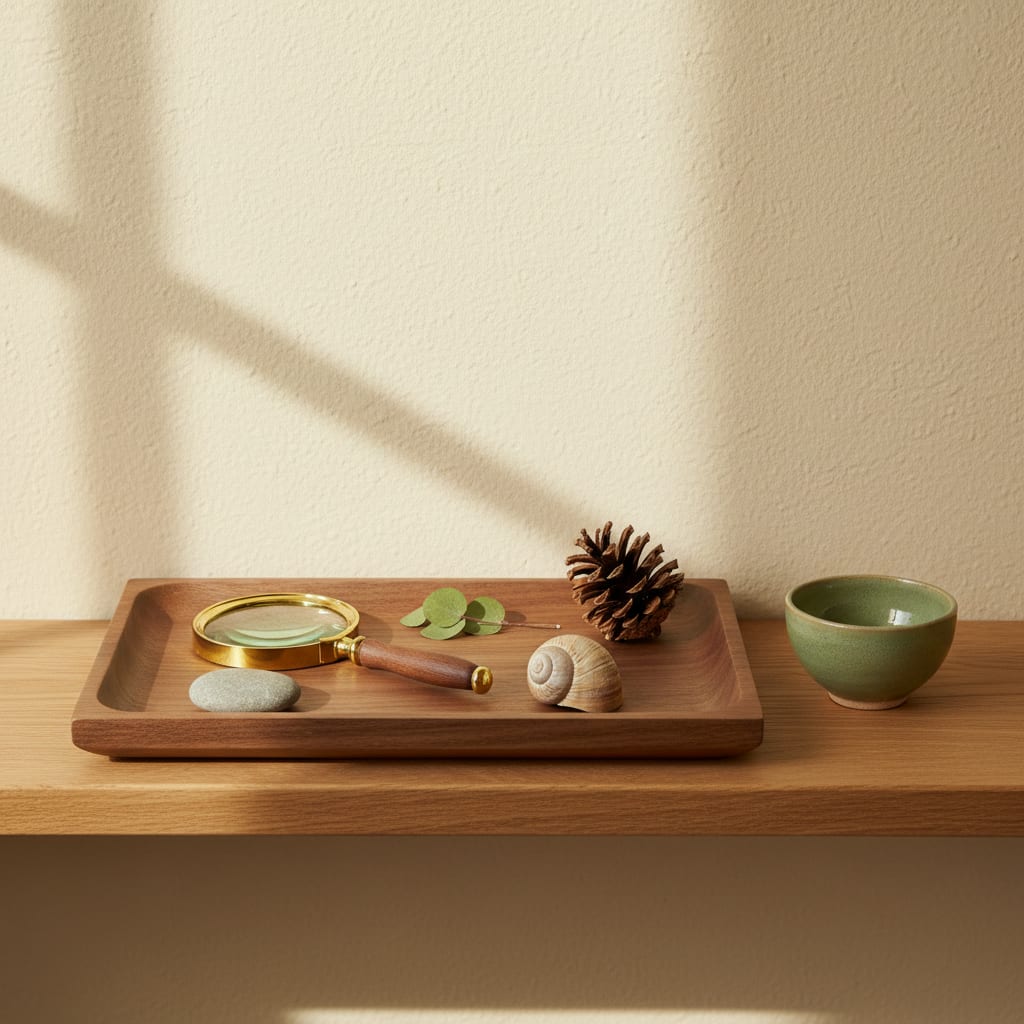
Small objects. The toddler who spots a crumb, an ant or a dropped sequin from across the room. Both AMS toddler guides list it. What helps: a magnifying glass on a walk, sorting work with safe-sized pieces. Keep choking safety in mind, because the child’s fascination and the hazard are the same object.
Refinement of the senses. Sorting by colour, size and texture, listening for quiet sounds, insisting on touching everything. What helps: sorting and matching work, nature baskets, the silence game.
Social life and manners. Toward three to six, a growing interest in other children and in how people treat each other. AMS’s two-year guide lists “Social behavior (beginning)”. What helps: modelled greetings, turn-taking, simple role-play of polite phrases.
How to use the idea without overdoing it
The practical skill is observation. Watch for a week and write down what your child keeps returning to: what they repeat, what upsets them when it changes, what they stop to look at. That list is a better guide to what to put on the shelf than any age chart.
Then do three things:
- Make the interest easy to follow. A child in an order phase needs a predictable room. A child in a climbing phase needs somewhere safe to climb.
- Don’t fight a phase you can’t win. The toddler who insists on the same cup is not being difficult on purpose. Giving them the same cup costs you nothing.
- Let it pass. Interests fade once they have done their work, just as the AMI definition says.
What the idea does not mean
This is where online versions of the idea tend to go too far, so it is worth being plain.
- It is not a deadline. You will read that if you “miss the window”, a skill is lost forever. Nothing in the AMI definition above says so. Children who start reading, toileting or tidying later than a chart suggests still learn them. Montessori toilet learning makes the same point: starting “late” is fine.
- It is Montessori’s framework, not settled science. Montessori developed it from close observation of children over many years, and it remains a useful lens for parents. But a chart of sensitive periods by month is a teaching tool, not a medical measurement. If you are worried about a delay, talk to your pediatrician, not a chart.
- It is not a reason to push. If anything, it argues the opposite: offer, watch, follow. A child who is not interested in letters at three is probably busy with something else.
For how sensitive periods fit with the rest of the method, from the prepared environment to following the child, see what is Montessori parenting?.

FAQ: Montessori sensitive periods
What are the sensitive periods in Montessori?
They are stretches of time when a young child is intensely drawn to one kind of learning. AMI lists periods for language, movement, order, refinement, obtaining culture, social cohesion and sensory perception. Most parent guides group them as order, language, movement, small objects, the senses and social life.
What ages are the Montessori sensitive periods?
Mostly from birth to about six, the period Montessori called the absorbent mind. Each one has its own rough timing. AMS’s guides, for example, mark order as at its peak around age two.
What happens if you miss a sensitive period?
Nothing permanent. The AMI definition says a sensitive period disappears once the skill is obtained, not that the skill can no longer be learned. Children learn at their own pace, and plenty of skills arrive later than a chart says.
How do I know which sensitive period my child is in?
Watch what they repeat, what they notice and what upsets them when it changes. A child who insists on the same order every day, or who spots every crumb on the floor, is showing you.