Toddler Wants to Sleep in a Play Tent: A Montessori View
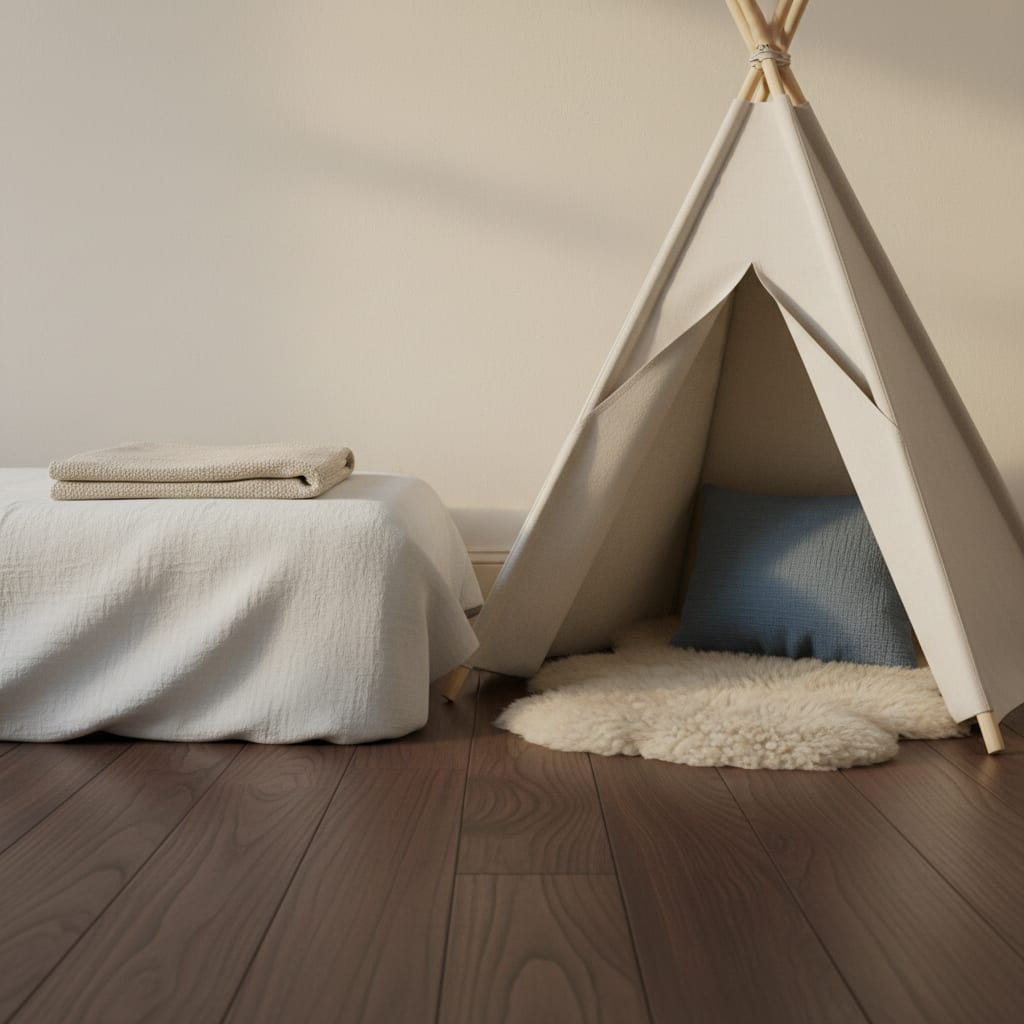
If your toddler wants to sleep in a play tent or a fort, the short answer depends on age. A baby under 12 months sleeps on a bare, firm, flat surface with nothing over it, so no tent and no canopy. For a toddler, a play tent is a toy, not a sleep product, so the Montessori answer is to read the request as information. The child wants a small, enclosed place that feels like theirs. You can usually give them that on the floor bed itself, and keep the tent for daytime.
I was an assistant in a Montessori toddler community, not a certified guide and not a clinician. The safety points below come from the American Academy of Pediatrics and the US Consumer Product Safety Commission pages named in each section.
Why a fort feels better than a bed
A tent gives a small child three things a bedroom often does not: walls close around them, a door they control, and a space that is clearly their own. Montessori homes already take that wish seriously. In his Montessori Foundation article Designing a Montessori Home, Tim Seldin writes that “children’s bedrooms should clearly reflect their personalities and current interests,” and that young children “have a tremendous need and love for an orderly environment.” The same article quotes Maria Montessori asking for “a small bed in which he can sleep at night under an attractive blanket he can fold and spread by himself.”
So a child who drags a blanket into the play tent at bedtime is telling you what kind of sleep space they want: smaller, enclosed, and theirs to arrange.
Under 12 months: no tent, no canopy
This part is not a Montessori question. The AAP’s parent guide to safe sleep says alternative sleep surfaces are only safe if they meet the federal standards for cribs, bassinets, portable cribs or play yards, and it lists “baby tents” among the products that must. It also asks for nothing soft in the sleep space: “pillows and pillow-like toys, quilts, comforters” and blankets all stay out. Its recommendations are “for babies up to 1 year of age.”
A play tent meets none of that. If a crawling baby falls asleep inside one, move them to their own sleep space, on their back.
Toddlers: what the recalls show
Two CPSC recalls are worth knowing.
- Tents fixed over a crib or play yard. In 2012 the CPSC recalled about 330,000 Tots in Mind crib and play yard tents, which it said “can present an entrapment and strangulation hazard to infants and toddlers.” It reported 27 tent failures, including the death of a two-year-old boy. The lesson goes wider than one brand: do not fix a cover or dome over a crib or play yard at any age.
- Fabric canopies over a child’s bed. In 2014 the CPSC recalled IKEA’s children’s bed canopies because “an infant or young child can get entangled at the neck in the canopy’s fabric.” One US report involved a 7-month-old who pulled the fabric into her crib.
The AAP’s guide to making a baby’s room safe says the same about ordinary cords: “Don’t let strings or cords dangle in or anywhere near the crib.” That is why the peaked roof of a house-style floor bed frame should stay bare. The floor bed guide on this site already notes that the roof “does nothing functional.” Draping it in fabric or bunting adds the exact hazard those recalls describe.
Bring the fort to the bed
For a toddler, this is usually the best answer: keep what the child likes about the tent, and drop the rest.
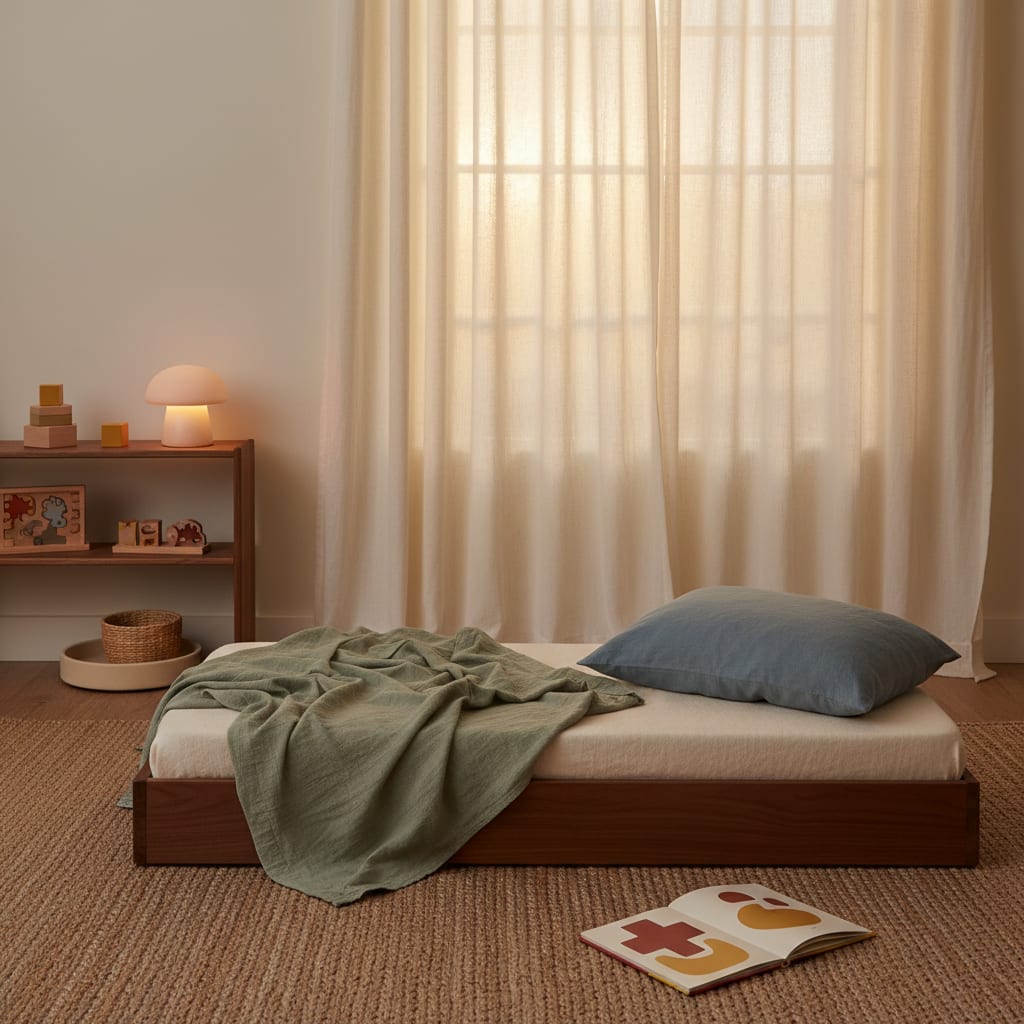
Move the bed into a corner. Two walls around a floor mattress give much of the enclosed feeling of a tent, with nothing overhead. Keep it away from the window. The AAP advises against placing “a crib—or any other child’s bed—near a window” because of blind and curtain cords.
Let the child arrange it. This is the Montessori part. Offer two or three choices: which wall, which blanket, which one book stays beside the bed. Then leave them to set it up. For a child old enough for bedding, the blanket they “fold and spread by himself” is Montessori’s own picture of a child’s bed. Pillows are a separate decision. Betteroo’s guide on when a pillow is actually worth adding suggests waiting until at least age 2.
Keep the light outside the fort. Many play tents are sold with a strand of star lights. For sleep, leave them in the box. The AAP asks you to “keep night-lights away from drapes or bedding where they could start a fire” and to “buy only cool night-lights that do not get hot.” Its holiday decorations guidance also warns that light strands “may contain lead,” and asks families to secure the battery compartments in string lights because button batteries can cause life-threatening injuries if swallowed. A low amber plug-in light such as the GE SleepLite, on the wall away from the bed, gives the dim glow without a cord in the bedding.
Give the tent a daytime job. A tent makes a good quiet corner: a cushion, a basket of three books, nothing else. A plain pop-up such as the Pacific Play Tents Primary Pop-up, is all a quiet corner needs. The quiet time post covers how to set up a prepared corner for the hour after the nap ends. “The tent is for the day, the bed is for the night” is easier to accept once the tent has a real job.
If you allow a fort night
Some families keep an occasional camp-out night for an older preschooler. Treat it as a planned event, not a nightly bargain:
- On the floor, never on the bed. The tent stands on the floor, over the child’s own firm mattress or mat. Nothing on top of the tent, nothing hanging from its roof.
- Door flap open, lights off. No string lights inside, and no cords or chargers within reach of where the child lies.
- Nothing heavy holding it up. Blanket forts are often built from chairs, a bookcase and a stack of books. The AAP’s tip-over guidance says to “secure all furniture and mirrors with anti-tip devices,” and notes that about half of fatal tip-over incidents happen in bedrooms, “sometimes when parents think their kids are asleep.” A fort that leans on furniture is a daytime build. Take it down before lights out.
- Same routine as any night. The tent changes where the child sleeps, not how bedtime goes.
- Check before you sleep. Look in once before you go to bed yourself, and move the child to their bed if anything has shifted.
Re-run the floor bed safety checklist after any layout change, a tent included.
When the fort is about something else
Sometimes the tent is just fun. A child who suddenly wants walls around them may be scared of the dark or worried about separation; one who only wants the fort after lights out may have found a new way to stall. Watch for a week before you change anything. If the fort comes with a story about what is outside it, the pretend play post covers how a Montessori home handles imagination without feeding a fear.

FAQ: the child who wants to sleep in a fort
Is it safe for a toddler to sleep in a play tent?
A play tent is a toy, not a sleep product. Under 12 months, never. For an older child, an occasional camp-out can work if the tent is on the floor, with nothing hanging inside, no lights and nothing heavy holding it up. If unsure, ask your pediatrician.
Can I put a canopy over my toddler’s floor bed?
Skip it while your child is young. The CPSC recalled IKEA’s children’s bed canopies in 2014 because a young child could get entangled at the neck in the fabric.
Can I put a tent over a crib?
No. The CPSC recalled about 330,000 crib and play yard tents in 2012 after reports of entrapment and strangulation, including the death of a two-year-old.
How do I make a floor bed feel cozy like a fort?
Put it in a corner, away from the window, let the child choose the blanket, and keep a cool, dim night-light on the wall.