Montessori Mobile vs Crib Mobile: Where It Hangs, When It Goes
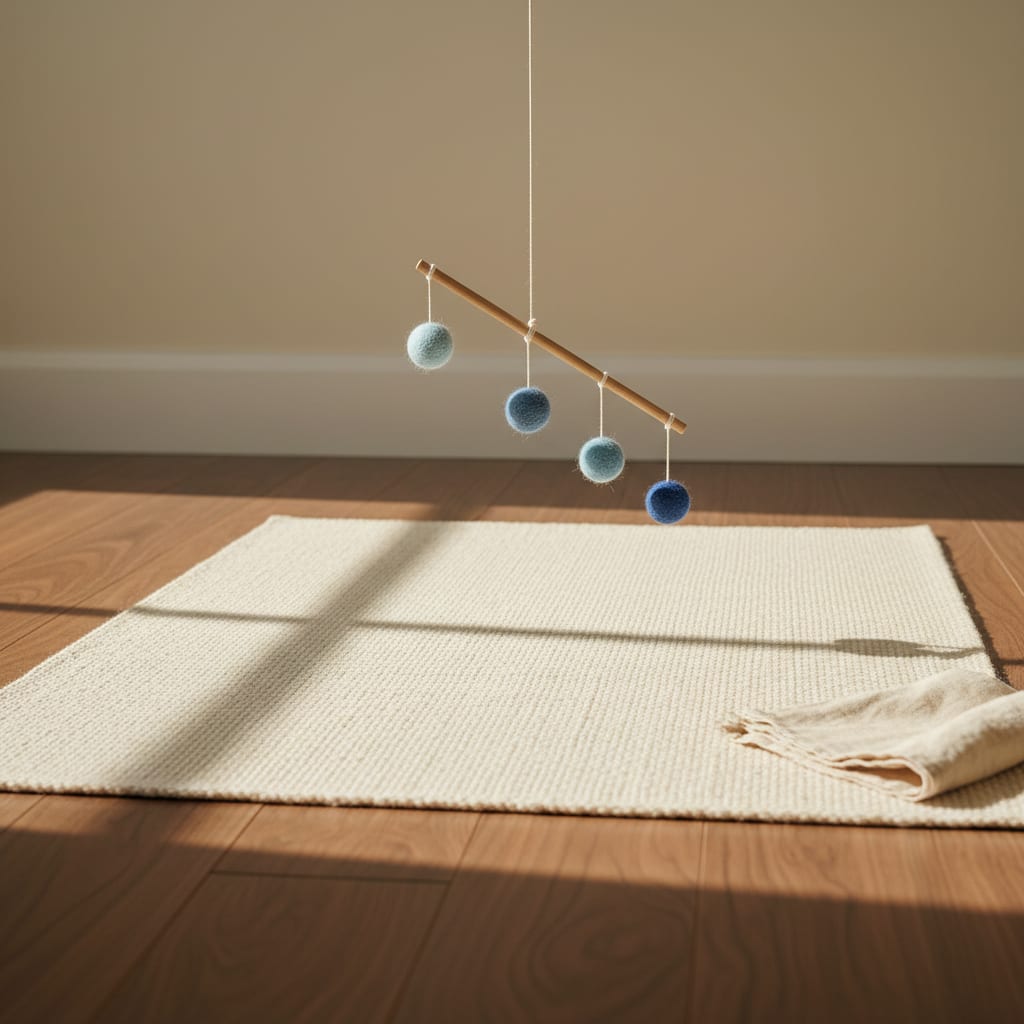
In a Montessori home the mobile hangs over the movement mat, where an awake, fed baby can study it, and the crib stays bare for sleep. If you do hang a crib (or cot) mobile, the American Academy of Pediatrics’ rules are short: attach it securely, keep it out of reach, and take it down when your baby can get up on hands and knees or turns 5 months, whichever comes first. The classic visual mobiles were never meant for the bed. They are daytime work, and the bed has one job.
I was a classroom assistant in a Montessori toddler community and hold no guide’s diploma, so read this as house rules built on what pediatric safety pages and a Montessori school actually say, not as doctrine.
Two different objects with the same name
A crib mobile is usually sold as part of the bedtime picture: something to watch, sometimes to wind up or switch on, while the baby drifts off. The Montessori visual mobiles (the Munari, the octahedron, the Gobbi and the dancers) are a sequence of things to look at, hard, while wide awake.
The Montessori Academy of New Jersey, an AMI-accredited school, says where they belong in its materials spotlight on Montessori mobiles: “Montessori mobiles are meant to be used in a movement area, rather than above a changing area or sleeping area. Interacting with the mobiles is important work for babies and they need prepared space for that work.” It also says a mobile should hang “about 12 inches in front of them rather than directly above”, on roughly a 45-degree line from the baby’s eyes.
| Crib mobile | Montessori visual mobile | Tactile mobile (bell or ring on a ribbon) | |
|---|---|---|---|
| Hangs over | The sleep space | The movement mat | The movement mat |
| Baby’s state | Settling to sleep | Fed, rested, awake | Awake and reaching |
| Reach | Must stay out of reach | Looked at, not grasped | Made to be grasped and pulled |
| Adult | Often out of the room | Nearby | In the room the whole time |
| Comes down | Hands and knees or 5 months, whichever is first | When interest fades; the next one goes up | Whenever you leave the room (my rule) |
The full sequence, and what each mobile shows a young eye, is in Montessori toys for 0-6 months. This post answers the question that page leaves open: what goes over the bed.
What the safety pages say about crib mobiles
None of the pediatric pages I read bans a crib mobile outright. They set conditions, and the conditions are firm.
The AAP’s HealthyChildren baby’s room checklist says: “If you hang a mobile over your child’s crib, be sure it is securely attached to the side rails, wall or ceiling. Hang it high enough so your baby cannot reach it to pull it down. Be sure to remove it when he is able to get up on his hands and knees, or is 5 months old, whichever comes first.” It adds that “Crib gyms are not recommended, as infants and toddlers may injure themselves falling forward onto the gym or pulling the gym down on top of their body.” Nemours KidsHealth’s crib safety checklist agrees, and adds: “There are no mobiles or toys with strings or ribbons that your baby could reach.”
Note “whichever comes first”: 5 months is the latest date, not the target, so an early mover loses the mobile early.
For the bed itself, the AAP’s safe sleep guide says to “Keep soft objects & loose bedding out of your baby’s sleep area”, and its list includes toys. A mobile above the crib is not inside it, but the principle points the same way: the sleep space stays plain.
On a floor bed, these pages talk about cribs, so I will be careful. Their reasoning, that a hanging thing becomes dangerous once the baby can reach it, applies at least as strongly on the floor, where there is no rail. My floor bed safety checklist already keeps the wall above the mattress clear and every cord out of reach, and I treat a mobile the same way: none over a floor bed. Ask your pediatrician if you are unsure.
Why a Montessori room keeps the mobile off the bed
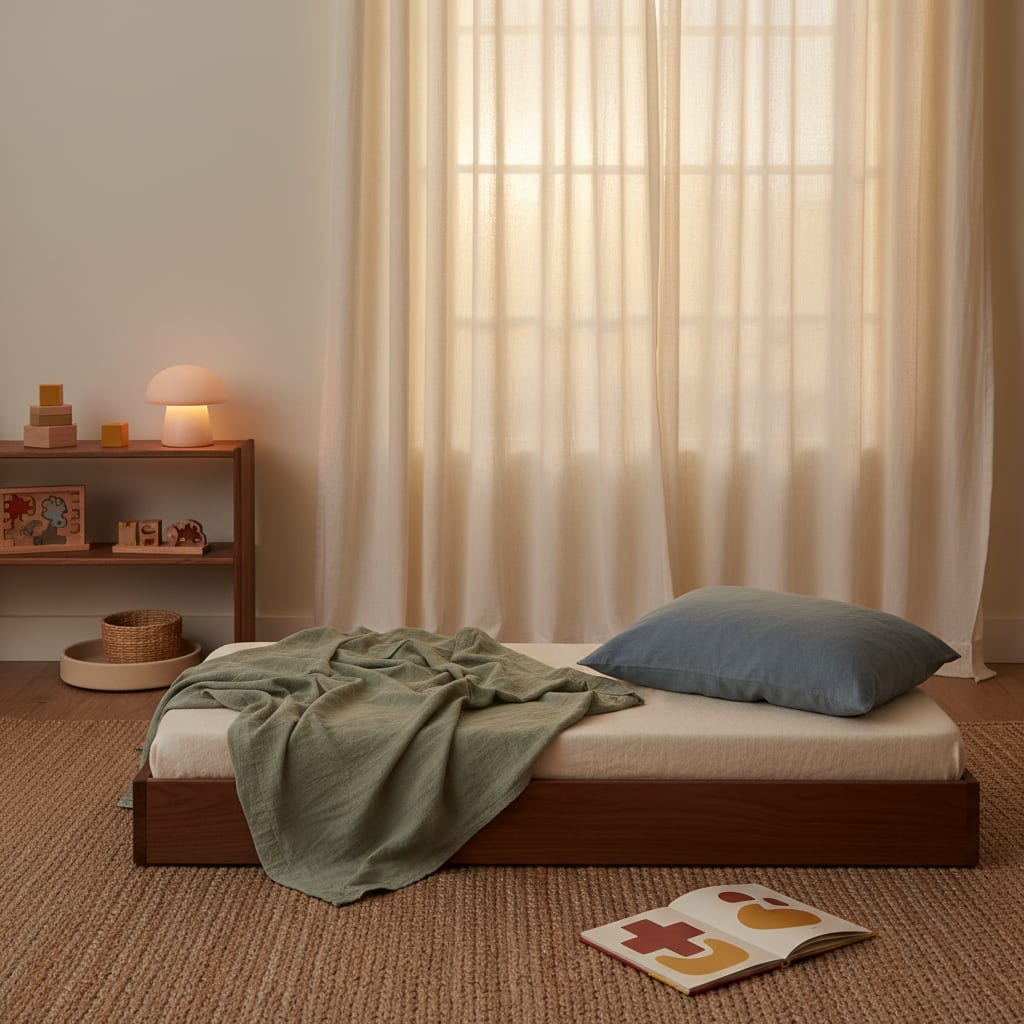
Each area has one job. A Montessori infant room has a few zones: sleep, movement, feeding and care, laid out in a Montessori infant room on a normal budget. The mobile belongs to movement, which keeps the bed meaning sleep.
A mobile is stimulation, used in short doses. MANJ offers each mobile “for short periods of time and then take a break if babies seem to be overstimulated,” and says “The best time to use the movement area and the mobiles is when babies are fed and well-rested.” That is focused, awake attention: what you want on the mat mid-morning, not at the start of a nap.
The timing collides with a sleep change. If a mobile is part of how your baby falls asleep, it has to go by 5 months. Betteroo’s guide to how long a four-month-old can stay awake between sleeps describes this age as the one when “Sleep cycles mature, naps get pickier”, and calls the four-month change “a permanent maturation of sleep”. To my mind, removing a familiar going-to-sleep prop in that same window means two changes at once. A baby who never had a mobile over the bed has nothing to lose there.
How to use a mobile on the mat instead
You need a firm mat or low-pile rug, a hook, and one mobile at a time.
- A ceiling hook, or a frame. MANJ describes “a mat and a hook on the ceiling for hanging the mobiles”, with a ribbon ending in a key ring so mobiles swap quickly. If you would rather not drill, a freestanding wooden frame does the same job. The Lovevery Play Gym is the well-known one: it stands on the floor and holds things over the mat. It costs more than a hook, so buy it for the frame, not the extras.
- Slightly in front, not straight down. Betteroo’s write-up of how a baby’s color vision fills in over the first months gives the same distance: “8 to 12 inches from your baby’s eyes is ideal, securely attached and removed once your baby can push up.” It also explains why the sequence opens in black and white: babies reach “good color vision by about 5 months”, not at birth.
- A mirror beside the mat. MANJ suggests one so a baby who turns their head can still see the mobile. Use shatterproof acrylic, fixed low.
- Fed, rested, short. Put the baby under the mobile soon after a feed. Stop when they look away or fuss.
- Tactile mobiles are supervised. The later bell and ring on a ribbon are meant to be grasped and pulled, and MANJ notes that “Older babies may also use this material to pull themselves up.” That is fine on the mat with you sitting there. It is also exactly the “strings or ribbons” the crib pages rule out, so take it down whenever you leave the room, and never move it to the bed.
If you are changing beds around this age too, see bassinet outgrown: crib or floor bed next?. Space the two moves apart so you can tell which one caused any new sleep trouble.

FAQ: crib mobiles and Montessori mobiles
Should I put a mobile over the crib?
You do not have to, and in a Montessori room you usually would not. If you do, the AAP says to attach it securely, keep it out of reach, and remove it at hands and knees or 5 months, whichever comes first.
When should a crib mobile come down?
When your baby can get up on hands and knees, or at 5 months, whichever happens first.
Does a mobile help a baby fall asleep?
Not in the Montessori tradition, where mobiles are for focused, awake work and are paused when a baby seems overstimulated. A mobile that has become part of falling asleep also has to come down by 5 months.