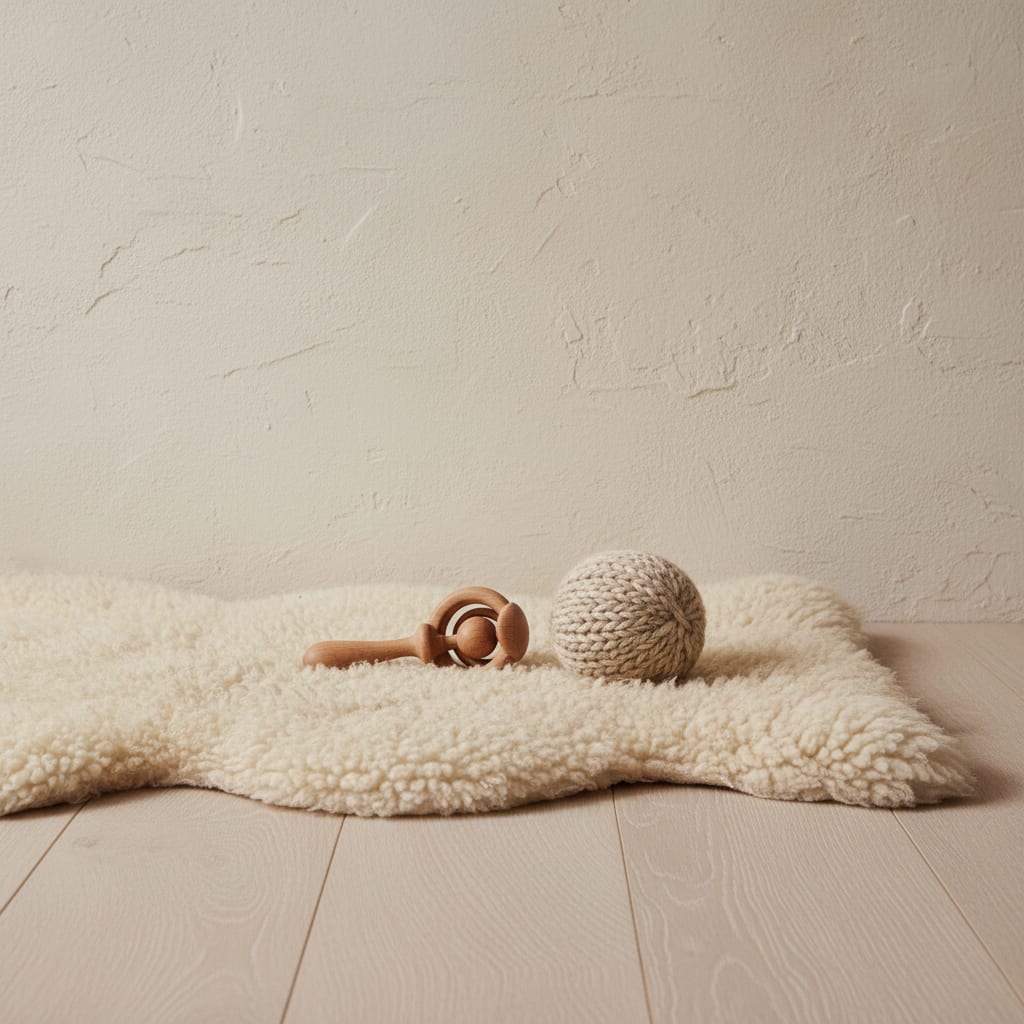
A sheepskin in a Montessori infant room is a floor-time rug, not a bed. Use it for awake, supervised time: lying under a mobile, reaching for a rattle, a few minutes of tummy time. Never let a baby sleep on it. The American Academy of Pediatrics tells parents to “never put your baby to sleep on an armchair, a sofa, a water bed, a cushion or a sheepskin,” and NIH’s Safe to Sleep campaign lists sheepskins among the soft surfaces that “are not safe for babies to sleep on.” If your baby dozes off on it, move them to their own firm, flat, bare sleep space.
I was a classroom assistant in a Montessori toddler community, not an infant specialist, and I hold no guide’s diploma. The safety rules below come from the AAP and NIH, quoted and linked. The Montessori side comes from Nicole Kavanaugh of The Kavanaugh Report, whose posts are linked too. Where the two pull apart, this site follows the AAP.
Why a sheepskin turns up in Montessori baby spaces
Montessori infant rooms often have a pale fleece on the floor. In How We’ve Used a Sheepskin, Kavanaugh explains why: a Montessori baby space “should be calm, peaceful, and beautiful, but still interesting,” and “a good sheepskin can provide a natural warmth, beauty and texture that is perfect for a baby space.”
She describes it changing jobs as her son grew. In the newborn weeks it was “a perfect place to set him down on the floor,” giving “a bit of warmth (it was winter) and softness from the hard floor.” Later it was a play spot she could move around the house, with a play gym or a mobile above it, and “an interesting texture for his hands.” As a toddler, it became a reading corner with a basket of books.
She is also plain that it is optional: “a faux sheepskin or other small calming rug could be used in the same ways,” and she knows “it may not be everyone’s preference.” Our Montessori infant room on a normal budget gets by with a firm mat or a low-pile rug, and that works just as well.
The line: awake on it, never asleep on it
Montessori writing keeps the two infant spaces apart, and that helps here. In The Movement Area verses the Sleep Space, Kavanaugh says “the main purpose of the sleeping space is sleep and not play/learning/exploration,” while the movement area “is for play.” A sheepskin belongs to the movement side.
The safety bodies explain why it can never cross over. The AAP’s page on reducing the risk of SIDS and suffocation lists “pillows, quilts, comforters, sheepskins, bumper pads and stuffed toys” as things that “can cause your baby to suffocate.” NIH’s ways to reduce baby’s risk puts sheepskins beside couches, memory foam and thick blankets as soft surfaces, and gives the reason: “Babies who sleep on soft surfaces may not be able to breathe due to entrapment or wedging, suffocation, or strangulation.”
What a baby sleeps on instead is the same in a Montessori home as anywhere else. NIH describes it as “firm (returns to its original shape quickly if pressed on), flat (like a table, not a hammock), level (not at an angle or incline), and covered only with a fitted sheet.” Betteroo’s checklist of what a bare, firm sleep space includes says the same thing in one line: a fitted sheet and nothing else.
A faux sheepskin is just as soft, so I treat it the same: the danger is the pile, not the fibre.
When your baby falls asleep on the sheepskin
A fed, content baby lying on something warm under a slow mobile is a baby about to fall asleep.
The AAP’s rule for a baby who drops off in a car seat, stroller, swing or sling is to “move them to a firm sleep surface on their back as soon as possible.” It doesn’t name rugs, but the reasoning carries over: the place they fell asleep isn’t where they sleep. Pick your baby up, carry them to the crib, bassinet or bare mattress, and lay them on their back.
Two habits make this easier:
- Watch, don’t step away. Floor time is awake time with an adult nearby. If you need to leave the room, take the baby with you or move them to their sleep space.
- Read the cues early. Kavanaugh’s newborn floor time lasted “5 to 10 minutes most of the time,” offered only when the baby’s other needs were met. When the eyes go heavy, floor time is over.
Tummy time on a sheepskin
The AAP’s parent guide to safe sleep asks for tummy time “while awake every day,” supervised by “an awake adult,” building to “at least 15 to 30 minutes of tummy time every day by the time they’re 7 weeks old.” Kavanaugh found the sheepskin “a great tummy-time motivator,” because her son liked the feel of the wool in his hands.
That fits the AAP’s conditions while the baby is awake and you are watching. But a deep pile gives under small arms. Betteroo’s week-by-week look at tummy time notes that more time on a firm surface helps a growing baby practise weight shifting and pushing up on their arms. Use both: the sheepskin for short, happy sessions, and the firm mat for longer ones.
Where the sheepskin should not go
Not in the crib, bassinet or floor bed. No sheepskin as a mattress topper, a liner, or “just for warmth.” Keep your baby warm with clothing or a wearable blanket.
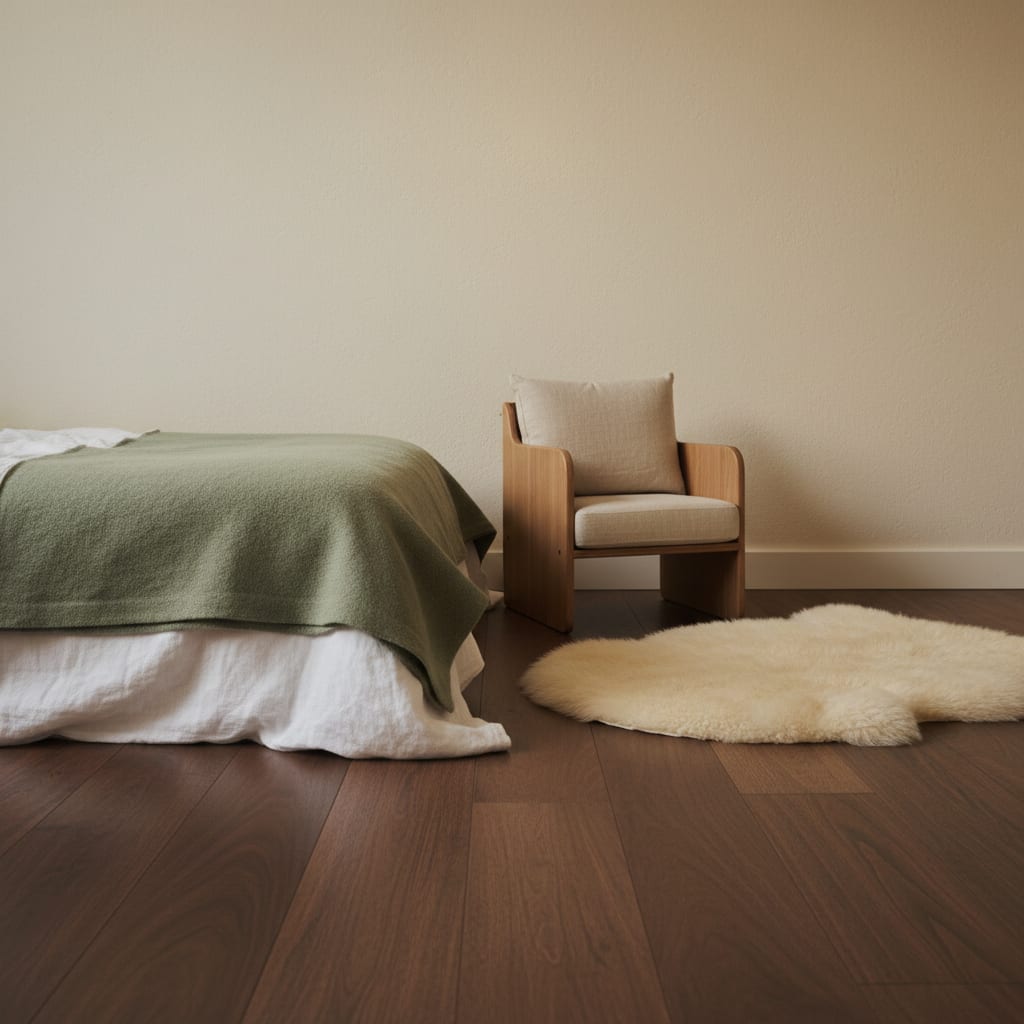
Not beside a floor bed for a baby under 12 months. Kavanaugh used hers as “a soft landing place for many months next to his floor bed” while her son learned to roll out. I would not copy that for a baby. If a baby rolls off in their sleep, they keep sleeping wherever they land. With a sheepskin there, they are now asleep on the surface the AAP says never to use. Keep the floor around the bed firm: bare boards or a thin, flat rug that lies tight to the floor. Our floor bed safety checklist covers the rest of that room. A floor bed for a baby this young carries its own questions too, which bassinet outgrown: crib or floor bed next? takes up.
Not on top of the topponcino. The Montessori topponcino is a holding pad, and it isn’t for sleep either. Stacking two soft things doesn’t make either one safer.
After the first birthday the picture changes. The AAP’s SIDS page notes that most experts agree soft objects “pose little risk to healthy babies after 12 months of age.” That is when a sheepskin can move to a reading corner, as Kavanaugh’s did.
Choosing one, if you want one
Look for a single pelt about 2 by 3 feet, big enough for a baby to lie on with a little room to reach. A short, dense pile is easier on small arms than long, loose fleece. One example is the WaySoft New Zealand sheepskin rug in 2 by 3 feet. Check the care label first: a baby rug gets spit-up.
 Naps on the rug, not in the bed?
Betteroo builds a gentle, personalized sleep plan around your baby's age, wake windows and naps, so sleep happens in the right place.
Take the free sleep quiz →
FAQ: sheepskins and babies
Is a sheepskin safe for a baby?
For awake, supervised floor time, yes. For sleep, no. The AAP and NIH both name sheepskins as soft surfaces a baby should never sleep on, because of the risk of suffocation.
What if my baby falls asleep on the sheepskin?
Move them to their firm, flat, bare sleep space, on their back, as soon as you notice. You don’t need to wait for a deeper sleep first.
Is a faux sheepskin safer than a real one?
Not for sleep. It is just as soft. Use it the same way: awake time only, with you watching.
Can I put a sheepskin next to a floor bed?
For a toddler past 12 months, many families do. For a younger baby who might roll out while asleep, keep the floor beside the bed firm and flat. If you’re unsure, ask your pediatrician.