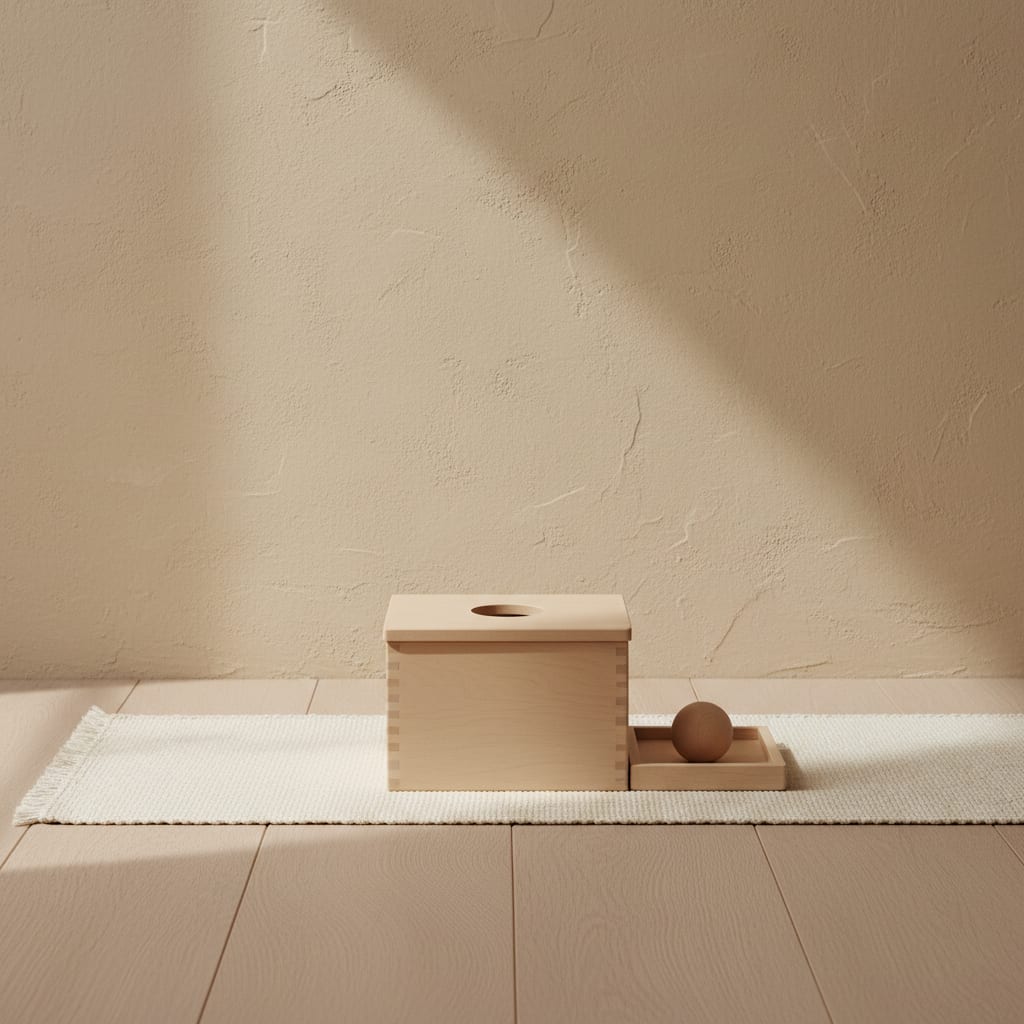
A Montessori object permanence box is a small wooden box with a round hole in the lid and an open tray at the front. The baby drops a ball through the hole, it disappears for a moment, and it rolls back out into the tray. Offer it once your baby sits steadily and has started looking for things that drop out of sight, usually somewhere between 6 and 10 months. Show it slowly twice, with almost no words, then hand it over and step back. When the tray version gets easy, the drawer version comes next.
I spent three years as an assistant in a Montessori toddler community and I’m not a trained guide. The presentation below follows Montessori teachers who write about it publicly, and the milestones come from the CDC.
What the box is for
The box is built around one idea: things still exist when you can’t see them. The Montessori teaching site Montessori Theory describes it as “designed around a single cognitive milestone: the understanding that something continues to exist even when it cannot be seen.” The ball vanishes, the ball comes back, and the baby does it again. And again.
That is why the box looks so plain. There is no music, no light and no cartoon on the side. A Montessori material isolates one thing, and here the one thing is the disappearance and return. Anything added to it gives the baby something else to look at. If you want the wider reasoning behind that, our guide to what makes a toy Montessori walks through it.
The CDC’s 9-month milestone list says it almost word for word. Among the things most babies do by 9 months, it lists: “Looks for objects when dropped out of sight (like his spoon or toy).” The spoon thrown from the high chair is the same experiment; the box gives it a tidy shape.
When to offer it
Watch the baby rather than the calendar. Montessori Theory gives most children a window of “between 6 and 10 months” and lists the signs that matter more than the age:
- Sitting without support. Both hands need to be free, and the body needs a steady base.
- Reaching on purpose. The baby picks up what they aim for.
- Dropping things deliberately. The high-chair phase, when every spoon goes over the edge to see what happens.
- Curiosity when something disappears. Leaning over to look for the toy that rolled under the sofa.
If the ball only goes in the mouth, it is too early. Put the box away for two or three weeks and try again. Nothing is lost.
For the rest of what belongs on a shelf in this half-year, see Montessori toys for 6 month olds, where the box sits alongside the treasure basket and the rolling toys.
How to show it
The Montessori way of presenting any material is to show it slowly, say very little, and then get out of the way.
- Set it down within reach, on a low table or a mat, with the tray facing the baby. Sit beside them.
- Name it once. “Ball. Box.” That is enough.
- Hold the ball above the hole for a moment, then let it drop.
- Wait while it rolls into the tray. Pick it up calmly. No “Where did it go?” and no cheering.
- Do it one more time at the same slow pace.
- Put the ball near the baby and stop talking.
Montessori Theory’s list of what not to do is the part most of us need: “Don’t clap when they succeed. Don’t redirect if they put the ball in sideways or miss the hole. Don’t ask ‘where did it go?’” The baby’s own surprise is the point. A parent’s excitement turns the work into a performance.
Then watch. Repeated dropping and eyes following the ball mean it is the right material. Throwing or ignoring it means too early. A bored baby dropping the ball without looking has finished with it.
The tray box, then the drawer box
There are two versions, and they work best in that order.
- Open tray (start here). The ball reappears on its own. Cause and effect is fast and visible, which is what a 6- to 8-month-old needs.
- Drawer. The ball drops into a closed drawer, and the baby has to pull it open to get it back. The ball is now out of sight until the child acts, which is a harder idea, and the pulling is a new hand skill. Montessori Theory places it from about 9 to 12 months.
After that come the boxes with different shaped holes, sometimes called imbucare boxes, and then posting and sorting work. That sequence carries on into the second year, and our Montessori toys for a 1 year old picks it up from there.
Buy one or make one
You don’t have to buy the box. A sturdy cardboard box with a round hole cut in the lid and the front cut open at the bottom does the same job, with a piece of card taped inside at a slant as a ramp. Smooth every edge, and post the ball through it ten times yourself before you hand it over. A box that jams teaches frustration, not permanence. Cardboard wears out fast with a keen baby, and by the time it does, the drawer version is usually due.
If you’d rather buy one, look for solid wood, a simple shape, a tray the ball can’t bounce out of and balls too big to be a choking risk. The Adena Montessori object permanence box is the example this site already uses: wooden, with a tray and three balls. Any box built the same way works the same way. The design is the point, not the brand.
On the balls: the AAP’s choking prevention page says to “follow the age recommendations on toy packages” and warns that “balloons, balls, marbles, pieces of toys and foods (small round objects) cause the most choking deaths.” Use only the balls that came with the box, or one at least as big, and count them back into the tray at the end.
Where it lives
Keep the box on the low shelf with two or three other materials, with the ball on the tray beside it rather than inside it, so the baby can see both parts. When they’re done, the ball goes back on the tray and the box goes back on the shelf.
The same idea turns up all over the first year: peekaboo, a toy under a cloth, a parent who leaves the room and comes back. Betteroo’s development guide covers the games and the separation-anxiety side of it, including why it often shows up at bedtime too.
 The ball comes back. So do you, at night.
Betteroo builds a gentle, personalized sleep plan around your baby's age, naps and routine, for the months when every goodnight feels like a disappearance.
Take the free sleep quiz →
FAQ: the object permanence box
What age is an object permanence box for?
Usually from about 6 to 10 months for the tray version, once the baby sits without support and starts looking for things that drop out of sight. The drawer version follows at around 9 to 12 months.
My baby just chews the ball. Is that normal?
Yes. It usually means it is a little early. Put the box away for a couple of weeks and offer it again.
Do I need to buy a Montessori object permanence box?
No. A cardboard box with a hole and an open front works the same way. A wooden one lasts longer and makes a satisfying sound, which is most of the difference.