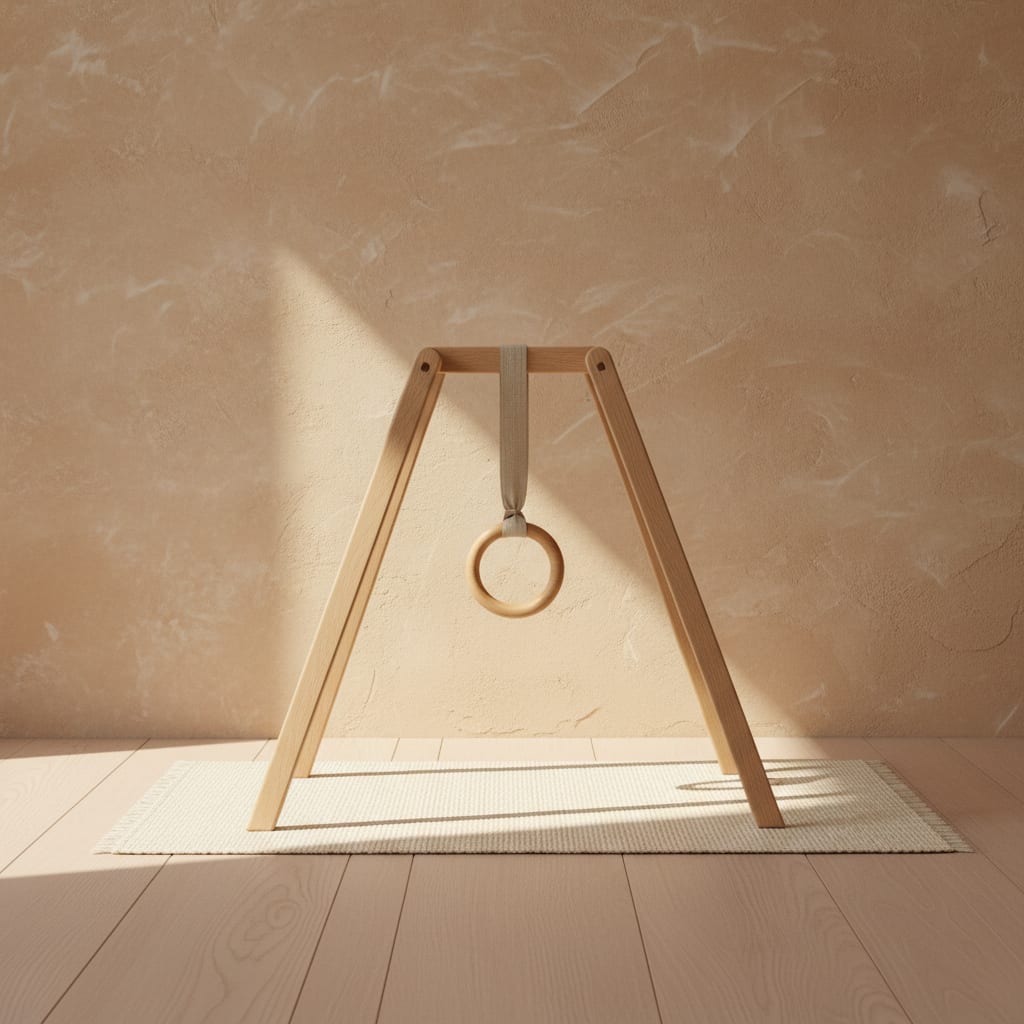
A Montessori play gym is a plain frame standing over a firm mat, holding one thing at a time for a baby to look at, bat or grasp: a mobile in the early weeks, then a ring or a bell on a ribbon. What a baby actually needs from it is short: a firm surface to move on, room to stretch, one interesting thing overhead, and an adult who changes that thing as the baby grows. Lights, music and five dangling toys at once are not part of it. A ceiling hook over a mat does the same job, so the frame is a convenience, not a requirement.
I was a classroom assistant in a Montessori toddler community, not a trained infant guide. The Montessori movement-area description comes from the Montessori Association of New Jersey, the tummy-time advice from the American Academy of Pediatrics, and the buying notes are general rather than a review.
What the play gym is for in a Montessori home
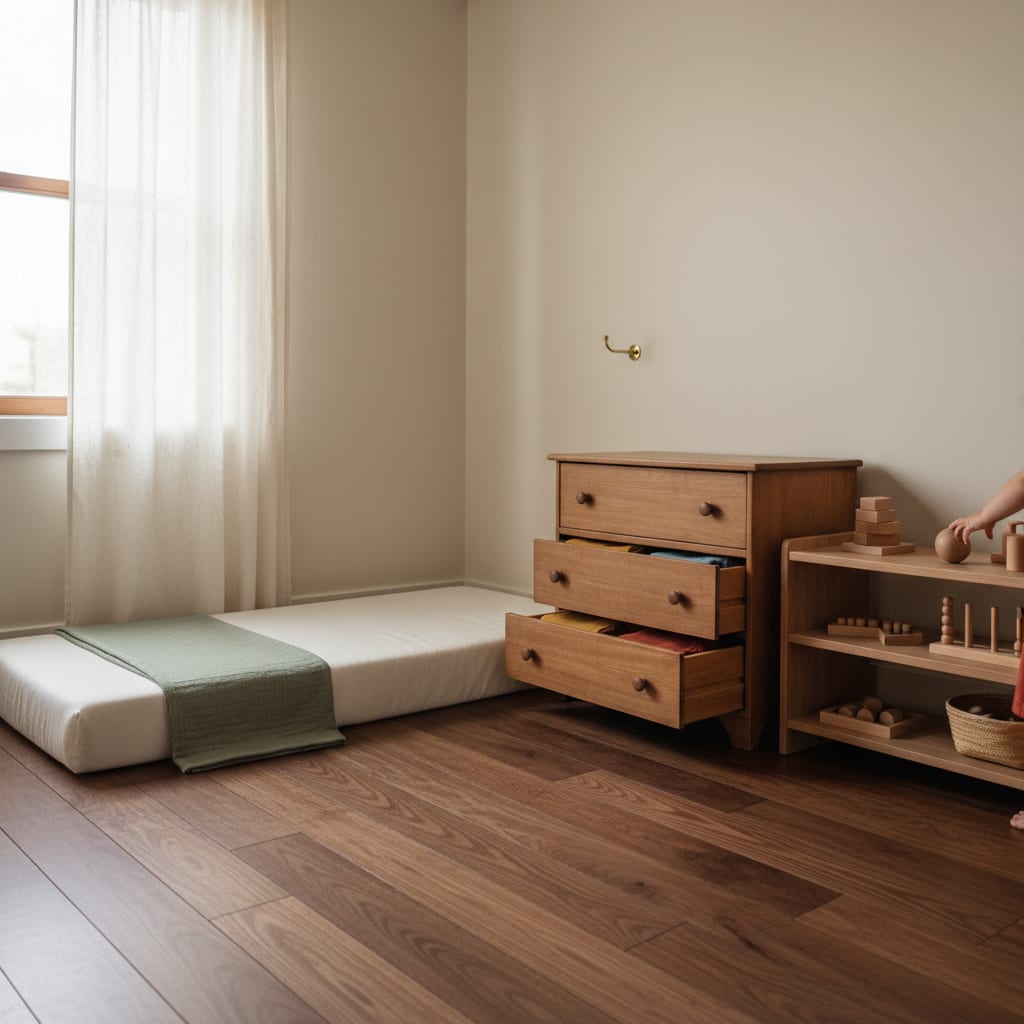
In Montessori infant settings, a play gym is part of the movement area, not a toy in its own right. The Montessori Association of New Jersey’s guide to Montessori mobiles describes that area simply: “The movement area includes a mat and a hook on the ceiling for hanging the mobiles.” It adds that it is “ideal for the movement area to have a mirror next to the mat,” so a baby who has their head turned to the side can still see the mobile in the mirror.
A frame replaces the ceiling hook. That is all it does. If you can’t or won’t drill into the ceiling, a freestanding wooden frame holds the same mobiles and rings at the same height, and it can move from room to room.
What the frame should not do is become the main event. The point is the object hanging from it and the baby’s movement toward it.
What it holds, stage by stage
The classic Montessori sequence moves from looking to reaching to grasping. Our post on Montessori mobiles and crib mobiles covers the visual mobiles in detail, so here is only the shape of it.
- Early weeks: something to look at. High-contrast and then simple coloured mobiles that move slowly in the air. MANJ notes that the traditional octahedron mobile, in red, yellow and blue, is usually introduced around two months.
- A few months in: something to bat. A light object within reach, which moves when the baby’s arm happens to hit it, so they start to connect the movement with the result.
- Later: something to grasp. MANJ describes the last mobile in the sequence as “a simple wooden ring hanging from a ribbon or elastic,” which lets babies “reach, grasp, release, and try again.”
One object at a time is the rule. Five toys hanging at once compete with each other, and the baby spends their attention moving between them instead of working at one.
For what else goes on the mat in these months, our Montessori toys for 0 to 6 months list covers rattles, grasping rings and the rest, and the Montessori infant room setup shows where the movement area sits in the room.
Tummy time belongs on the same mat
A play gym is mostly a back-lying setup, and babies need time on their fronts too. The AAP’s Back to Sleep, Tummy to Play page says tummy time “is for babies who are awake and being closely supervised,” and suggests playing with your baby on their tummy “2 to 3 times each day for a short time (3 to 5 minutes),” working up to “15 to 30 minutes each day by 7 weeks.”
The mat under the gym is the natural place for it. Turn your baby onto their front, move the mirror to face them, and put a single object on the floor just in front of their hands. If your baby dislikes it at first, the AAP suggests you “place yourself or a toy in reach for them to play with.”
What to look for in a frame
- Stability. It should not tip when a baby grabs and pulls on what hangs from it.
- Plain materials. Wood or another plain finish. The frame should be quiet so the object stands out.
- Adjustable hanging points. Hooks or a bar that lets you change the height and swap objects quickly.
- A firm mat underneath. A thin, firm mat or a rug, not a thick cushioned pad that makes rolling hard.
- Short hangers. Keep ribbons and elastic short, check attachments every time, and never leave a baby alone under the gym.
Betteroo’s buying verdict on baby gyms reaches the same place from a different direction: one mat with something to reach for is the whole decision, and a common mistake is paying for lights and music.
The well-known one
The Lovevery Play Gym is the gym most parents mean when they search for a Montessori one. It is a wooden frame over a large mat, with staged zones and a set of hanging toys, and it is far more expensive than a plain frame. Our sister site’s Lovevery Play Gym review covers what it does well and who should buy something cheaper, so I won’t re-review it here. From a Montessori point of view, the advice is the same whatever frame you own: hang one thing at a time, rotate it, and put the extras away.
What to skip
- Lights, sounds and batteries. If the gym is doing something, the baby is watching instead of moving.
- Gyms that hang everything at once. Take most of it off and rotate.
- Arches you can’t adjust. A frame that only holds its own toys at one height is harder to use with mobiles and rings.
- The gym in the cot. A play gym is for awake, supervised time on the floor. Sleep stays on a firm, flat surface with nothing hanging over or within reach.
 Awake on the mat, asleep in the cot?
Betteroo builds a gentle, personalized sleep plan around your baby's age, wake windows and naps, starting with a free quiz.
Take the free sleep quiz →
When to stop using it
The gym’s useful life ends when your baby is more interested in moving than in what hangs overhead. Once a baby rolls well, sits and starts to crawl, the frame usually becomes something to pull up on, and that is the time to take it down, or to check it is steady enough for that. The mat stays: it becomes the floor space for the next stage of movement.
FAQ: Montessori play gyms
Do I need a Montessori play gym?
No. A firm mat, a mirror and a ceiling hook for mobiles do the same job. A frame is useful if you can’t drill into the ceiling or want to move the setup between rooms.
What should hang from a Montessori play gym?
One thing at a time: a visual mobile in the early weeks, then something to bat, then a ring or bell to grasp. Rotate as your baby’s skills change.
When can a baby start using a play gym?
From the early weeks, on their back, while they are awake and supervised. Add tummy time on the same mat, building up gradually as the AAP suggests.
When should we stop using the play gym?
When your baby starts pulling up on it or crawling away from it. Keep the mat for floor play.