A sleep sack on a Montessori floor bed is the right choice for a baby and the wrong shape for a toddler who walks. Under 12 months, a wearable blanket is what the American Academy of Pediatrics suggests in place of loose bedding, and a mattress on the floor doesn’t change that. Once your child can stand up and walk away from the bed, a closed-bottom sack becomes a trip hazard in a room they are free to roam. At that point, switch to a sack with foot openings or to warm pajamas. After the first birthday a light blanket is also an option.
I’m not a trained Montessori guide or a sleep professional. The safety points here come from the AAP, the walking ages from the CDC, and the Montessori reasoning from Nicole Kavanaugh of The Kavanaugh Report, quoted and linked below.
Why this question only comes up with a floor bed
In a crib, the child wakes, stands at the rail and waits. The sack’s closed bottom doesn’t matter, because nobody is going anywhere.
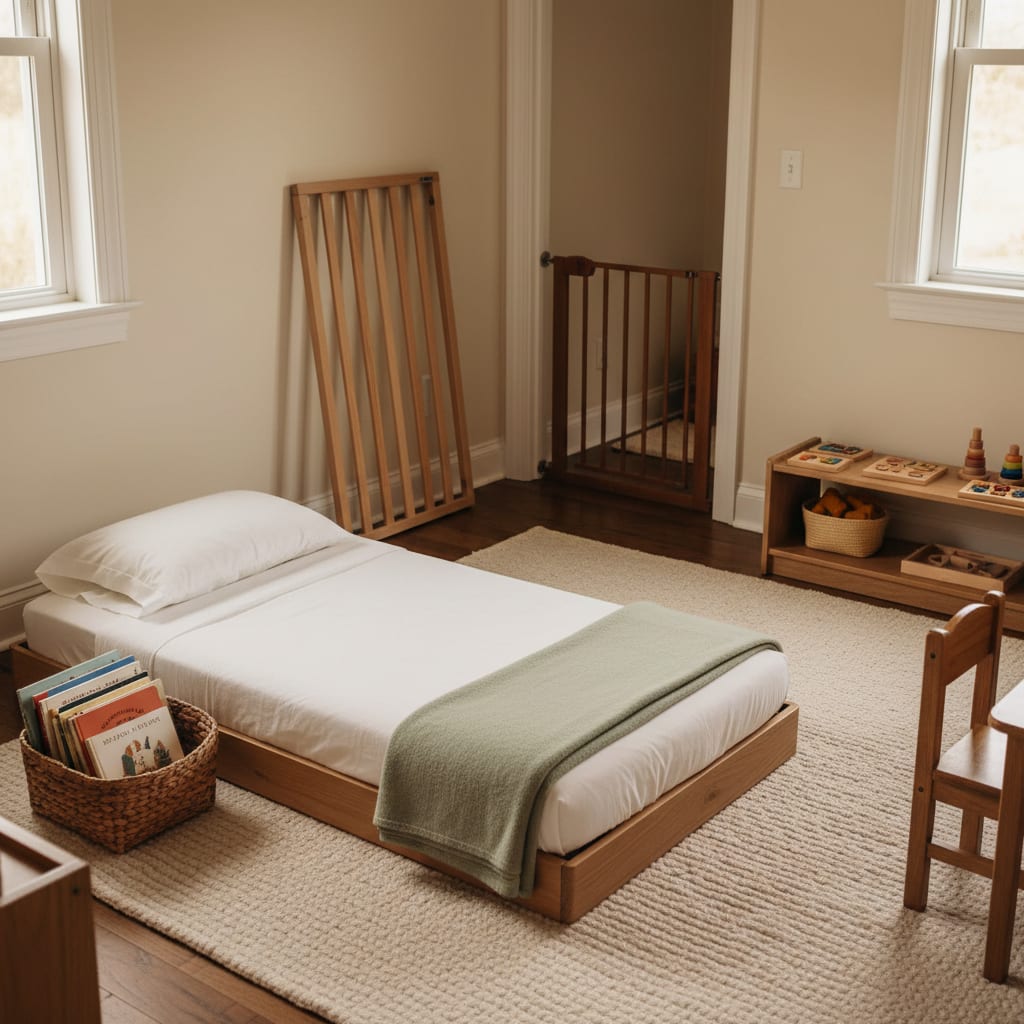
A floor bed removes the rail on purpose. As what a Montessori floor bed actually requires puts it, the whole room becomes the sleep space. A child who wakes at 5 a.m. can get off the mattress, cross the room and reach the door. So what they wear to bed has to keep them warm and let them move safely.
Under 12 months: keep the sack
For babies, the answer is simple. The AAP’s safe sleep guidance for parents lists blankets among the soft objects that “can increase your baby’s risk of entrapment, suffocation or strangulation.” Its alternative is this: “If you’re worried about your baby getting cold, you can dress them in layers of clothing or use a wearable blanket.”
A floor bed changes the height of the mattress, not the rules. A baby on one still sleeps on their back, on a firm, flat mattress with a fitted sheet and nothing else. The sack is how they stay warm.
The AAP adds two limits that apply to any sack:
- Fit. Its page on reducing the risk of SIDS and suffocation says: “If you use a wearable blanket, make sure it is the right size for your baby and it doesn’t cover their head.” Buy the size your baby is now, not the size they will grow into.
- No weight. The same guidance says: “Don’t use weighted blankets, sleepers, swaddles or other weighted objects on or near your baby.”
A baby who rolls or crawls off a floor mattress in a sack is a different matter from one who walks. I found no safety source that addresses crawling in a sleep sack, so I won’t make up a rule. Make sure the sack fits, keep the floor next to the bed clear, and ask your pediatrician if you’re unsure.
Once your child walks: the closed sack stops working
The CDC’s milestone checklists put first steps around 15 months (“Takes a few steps on his own”) and steady walking by 18 months (“Walks without holding on to anyone or anything”). Some children walk sooner. Once your child stands up on the mattress, they will try to walk in the sack.
A standard sack is a bag, longer than the legs so the child can kick. That works lying down. Standing up, the extra fabric is underfoot. Betteroo’s guide on when to stop using a sleep sack names the move to a toddler bed or floor bed as the most common reason families stop, because a child walking around a room can trip in a sack.
On a floor bed, that trip happens in the dark, alone, and often on a hard floor. If the bedroom door is open, it can happen near the stairs. The gate, the cords and the furniture anchors are in our floor bed safety checklist. The sack belongs on that list too.
There is also a Montessori reason. In Montessori Floor Beds and Young Toddlers, Kavanaugh writes that “with toddlers, the need for freedom of movement is still strong and essential to Montessori,” and that for her “the most important thing” is that her son “can get in and out of bed at will.” A low bed is there so the child can come and go. A garment that ties their legs together works against it.
Three things a walking child can wear instead
None of these is the “Montessori” answer. No such rule exists. Choose by your child and your room.
A sack with foot openings. These are sold as “walker” sacks. Betteroo’s roundup of toddler sacks says plainly that standard sleep sacks aren’t designed for walking, and that footed versions suit a child who is walking or moving to a bed. One example is the Kyte Baby Sleep Bag Walker. Fit matters even more here: legs that are too long put you back where you started.
Warm pajamas. This is the simplest change. If your child is used to the sack as a signal that sleep is coming, keep everything else about bedtime the same for the first week.
A blanket, after the first birthday. The AAP’s SIDS page notes that “most experts agree that these objects pose little risk to healthy babies after 12 months of age.” Kavanaugh added “a pillow and a couple blankets” to her son’s floor bed, and she notes those “were made after he turned a year old.” She also quotes Maria Montessori on a child’s “small bed in which he can sleep at night under an attractive blanket he can fold and spread by himself.” A toddler won’t keep a blanket on all night. Dress them warmly enough that it doesn’t matter.
Whichever you choose, the room matters as much as the clothes. Aim for about 68 to 72°F (20 to 22°C). The Betteroo stop-the-sack guide says to check the back of the neck or the chest for overheating, not the hands or feet.
Let your child do the zip
Bedtime dressing is practical life. The CDC’s 18-month checklist includes “Helps you dress him by pushing arm through sleeve or lifting up foot.” So a child who has just started walking can already help.
- Lay the sack or pajamas out flat on the bed and let your child step or sit into them.
- Start the zip yourself and let them pull it the last few inches.
- Offer two choices at most.
If dressing for bed has turned into a fight, our post on the toddler who wants to sleep in day clothes sorts out which parts are yours to decide.
 Out of the sack and out of bed?
Betteroo builds a gentle, personalized sleep plan around your child's age, naps and wake-up time, so a new freedom doesn't undo the nights.
Take the free sleep quiz →
Don’t use the sack to keep a child in bed
Some parents keep a walking toddler in a closed sack because it slows them down. On a floor bed that defeats the purpose of the bed, and it adds a fall risk. If your child isn’t ready for a room they can walk around, they may not be ready for the bed yet either. Our guide on when to switch a toddler to a floor bed lists the readiness signs. It is fine to wait.
FAQ: sleep sacks and floor beds
Can a baby on a floor bed wear a sleep sack?
Yes. Under 12 months the AAP suggests a wearable blanket or layers of clothing in place of loose blankets, on a floor bed as in a crib. Use the right size, and never a weighted one.
When should a floor bed toddler stop wearing a closed sleep sack?
When they start standing and walking away from the mattress. The CDC checklists put first steps around 15 months, and some children are earlier. No safety body sets a date, so it is a practical decision.
Are sleep sacks with foot openings safe on a floor bed?
They are designed for children who walk. The risk is poor fit, since long legs bunch under the feet. Check the fit when you buy and again after each growth spurt.
Does Montessori say anything about sleep sacks?
I couldn’t find anything. What Montessori writers stress is that the child can move freely and get in and out of bed alone. Judge what your child wears to bed by that. If you have safety questions, ask your pediatrician.