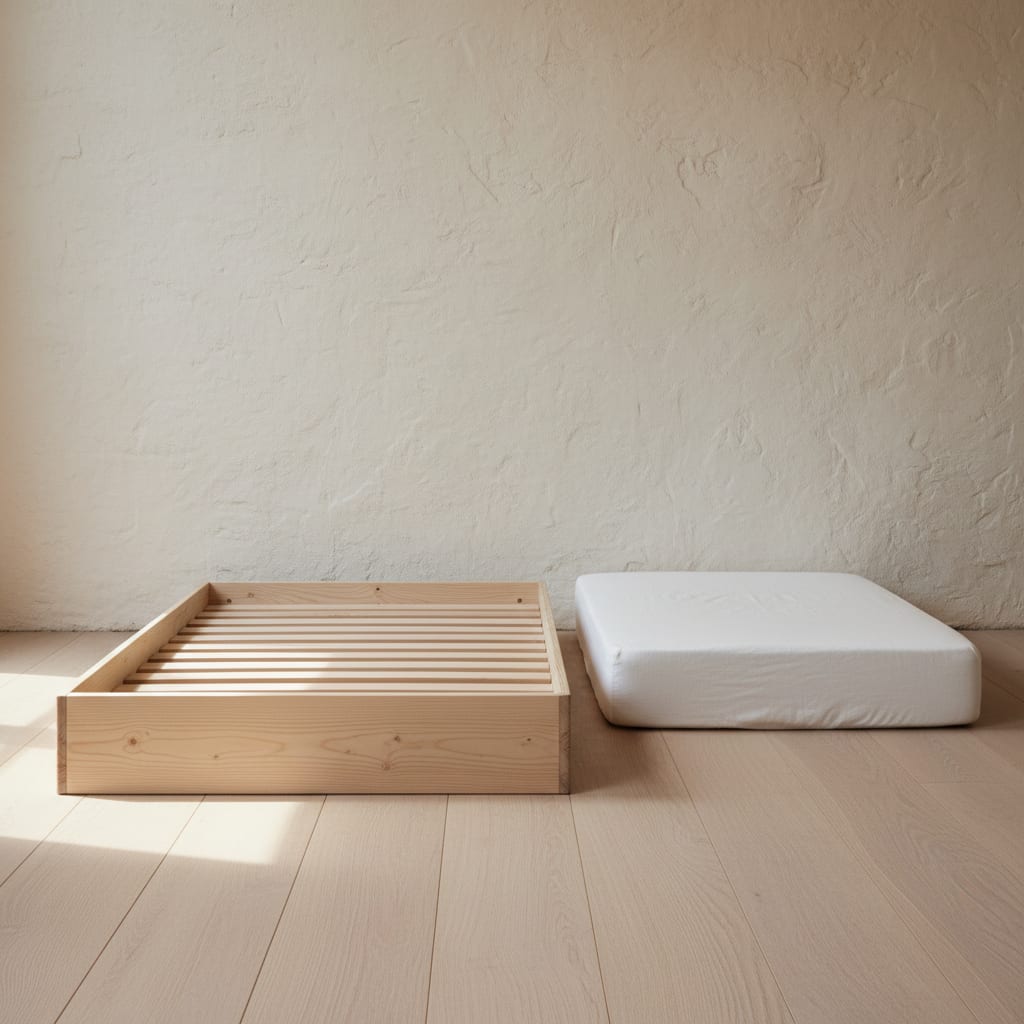
A Montessori floor bed frame is optional. A firm mattress on the floor is the original version, and it is still the right one for a baby or a new walker. A low slatted frame earns its place once your child climbs confidently, mainly because it lets air under the mattress. A house bed, the frame with a peaked roof, is a low frame with decoration on top. Whatever you choose, judge it on five things: can your child get in and out alone, are there any gaps a head or limb could wedge into, how high are the rails, does it fit the mattress snugly, and does the roof invite climbing.
I was an assistant in a Montessori toddler community, not a trained guide, and I’m not a safety engineer. The safety lines below are quoted from the AAP’s HealthyChildren site and the U.S. Consumer Product Safety Commission. The buying judgments are mine, from house use rather than spec sheets. For what a floor bed is and when to start, see our Montessori floor bed guide; this post is only about what goes under the mattress.
First, the age line
For babies under 12 months, the sleep surface rules come before any frame question. The AAP’s parent guide to safe sleep asks for “a firm, flat sleep surface”, explains that firm means “it shouldn’t indent when your baby is lying on it”, and names “a crib, bassinet, portable crib or play yard that meets the safety standards.” A floor mattress is not on that list. If you use a floor bed for a baby, talk it through with your pediatrician, keep the sleep space bare (fitted sheet only), and read our floor bed safety checklist before anything else.
The CPSC’s toddler bed definition is a useful second marker. A toddler bed is “sized to accommodate a full-size crib mattress” and is “intended to provide free access and egress to a child not less than 15 months of age and who weighs no more than 50 lbs.” That phrase, free access and egress, is about as close as a federal regulation gets to the Montessori idea of a bed the child can leave.
Why a Montessori bed sits so low
Maria Montessori’s own words explain it. Nicole Kavanaugh quotes her in Montessori Floor Beds and Young Toddlers: “the child instead should be given a low couch resting practically upon the floor, where he can lie down and get up as he wishes.”
Kavanaugh’s own reading is the one I’d use when shopping: “It doesn’t literally have to be a bed on the floor… It just needs to be independently accessible.” Her son wasn’t a strong climber yet, so his mattress stayed on the floor, and she planned a frame “as he gets more confident climbing.” That’s the right order. The child’s movement decides the frame, not the catalogue.
Option 1: no frame at all
What it is: the mattress straight on the floor, or on a rug.
Good for: babies (with the AAP caveats above), new walkers, roll-off weeks, rentals, and anyone not yet sure the floor bed will stay.
Watch for: airflow. A mattress flat on a floor can trap moisture underneath, especially in a humid room or on a cold floor. Lift it and check the underside regularly. If you see damp or mildew, a slatted base is the fix, not a thicker mattress.
Cost of getting it wrong: almost nothing. You can add a frame later.
Option 2: a low slatted frame
What it is: a plain rectangle of wood with slats, holding the mattress a few inches off the floor. Some have no rails; some have a low rail on part of one or two sides.
Good for: confident walkers and climbers, damp rooms, and families who want the bed to look like furniture.
What to check:
- Height against your child’s knee. Stand your child beside it. If the top of the mattress is above knee height, getting in becomes a climb rather than a step.
- Slat gaps and the edges of the mattress. Push the mattress hard against one end and look at the gap at the other end and along the sides. The AAP wants a crib mattress that “fits tightly”, and the same logic applies to any frame for a small child. The CPSC says its toddler-bed rule exists to reduce entrapment at “bed end structures”, because “Entrapment of a child’s head or neck can result in asphyxiation.” If a gap could take a child’s head, hand or foot, return the frame.
- Corner posts. The CPSC also flags “corner post extensions, which may catch pacifier cords”. Flat corners are better than posts that stick up.
- Rails. A low rail can stop a roll-off. Once it becomes high enough that your child has to climb over it, it has stopped being a floor bed. Leave a clear, full-width opening on at least one side.
A worked example: if you’d rather buy from an established children’s furniture maker than an unknown brand, the Delta Children Jordan toddler bed is sold as a low-to-floor toddler bed with safety rails that fits a full-size crib mattress. It’s a conventional toddler bed rather than a “Montessori” one, so run the same checks on it: the knee test with your own child, the mattress gaps, and an opening wide enough to step out of.
Option 3: a house bed
What it is: a low frame with posts and a peaked roof shape over it, sometimes with rails and a “door” opening.
Good for: families who love the look, and children who like a cosy, enclosed spot.
What to check:
- The roof is decoration. It does nothing for sleep. If you like it, fine; if you’re choosing on budget, skip it.
- The roof as a climbing frame. Posts and roof beams are a ladder to a toddler who climbs. Watch your child with it for a week before you trust it. If they try to climb the posts, take the roof off (many unbolt) or switch to a plain frame.
- Things hung from the roof. Garlands, fabric canopies and fairy lights draped on the roof put cords and fabric right over the mattress. Leave the roof bare.
- Stability. A tall house frame can wobble if a child pulls on one post. Check it’s rigid when assembled. If it isn’t, don’t use it.
- The same gap, rail and post checks as the slatted frame.
One reader in the comments under Kavanaugh’s post describes using “an Ikea frame with the legs cut off” with a mattress. It’s a good reminder that the simplest frame is usually the right one.
Crib mattress or twin?
This is the other big frame decision, because the frame fixes the mattress size.
- Crib size suits a younger toddler and a smaller room, and the CPSC toddler-bed definition is built around it. It will be outgrown, usually somewhere in the preschool years.
- Twin size lasts much longer and leaves room for a parent to lie down at story time. It also takes up more floor space, which a Montessori room needs for work and movement.
Whichever you choose, buy the mattress first or at the same time, and check that it fills the frame. A crib mattress in a twin frame leaves exactly the gaps you were checking for. For the mattress itself, see what a floor bed actually requires.
What not to buy
- Frames with tall rails all the way round. They are cribs with a gate, not floor beds.
- Anything with a gap you can fit your fist into along the mattress edge.
- Frames that need the mattress to sit above your child’s knee.
- Extras that hang over the bed: canopies, garlands, string lights.
- A frame you can’t get fully rigid. Return it.
If you’re furnishing the whole room on a small budget, a mattress on the floor and the money spent on anchoring furniture is a better trade than any frame. Our Montessori bedroom on a budget shows how.
Still deciding whether to leave the crib at all? Betteroo’s guide makes the case for keeping the crib until it stops being safe, which is a fair counterweight to everything above.
 New bed, same bedtime?
Betteroo builds a gentle, personalized sleep plan around your child's age, naps and the move to a new bed, so the first weeks stay calm.
Take the free sleep quiz →
FAQ: Montessori floor bed frames
Do I need a frame for a Montessori floor bed?
No. A firm mattress on the floor is the original Montessori version. A low slatted frame mainly adds airflow and looks, and makes sense once your child climbs confidently.
Is a house bed Montessori?
A low house bed can be, if your child can get in and out alone without climbing over a rail. The roof itself is decoration. If your child climbs the posts, take the roof off or choose a plain frame.
What size mattress should a floor bed frame take?
A crib mattress suits younger toddlers and small rooms; a twin lasts longer and fits a parent at story time. Either way, the mattress must fill the frame with no gaps at the edges.
Can a baby use a floor bed frame?
The AAP’s safe-sleep guidance for babies under 12 months names a crib, bassinet, portable crib or play yard that meets safety standards, on a firm, flat surface. Talk to your pediatrician before using any floor bed for a baby.